

Resistance: The Enemy Within
For every force, there is a reaction equal and in opposite direction. We are all familiar with this principle which is known as Newton’s Third Law.[1] It’s very easy to observe this principle with objects; if you run faster, you will feel the wind hitting your face harder. If you try to swim forward, you will feel the water pushing you back. Engineers intuitively know to take the air resistance into account when designing a plane, since the air resistance will act upon the plane as it moves forward. So, why can’t we consider resistance when we decide to move forward in our lives; when it comes in all forms and is all around us?
You’re sitting in your bed in the middle of the night, and suddenly you’re struck by an intense wave of inspiration. At that moment, you decide that you’re going to make radical changes in your life; you’re going to start working out the way you’ve always wanted to, read the books that have gathered so much dust from sitting on your shelf, work on that assignment you’ve been neglecting for the last couple of weeks and listen to that podcast you’ve been wanting to listen to for months. You feel that you finally have the motivation to reinvent yourself; it’s a new chance. You go to sleep dreaming of how great your new life is going to be. But then, you wake up in the morning, and all that inspiration is gone. How could it be? You felt like you could conquer the entire world just before you went to sleep, and now you don’t even have the energy to pick up your dirty socks and put them into the laundry basket. Does this sound familiar to you?
This wave of inspiration is actually a calling from what Nietzche calls ‘a higher self’[2], demanding that we start moving in the direction of a superior life. However, answering this call is not an easy task. The sudden wave of inspiration can only take us so far. Once the hit of inspiration ceases, we tend to fall back into our old habitual ways and continue to lead a life of misery and mediocrity.
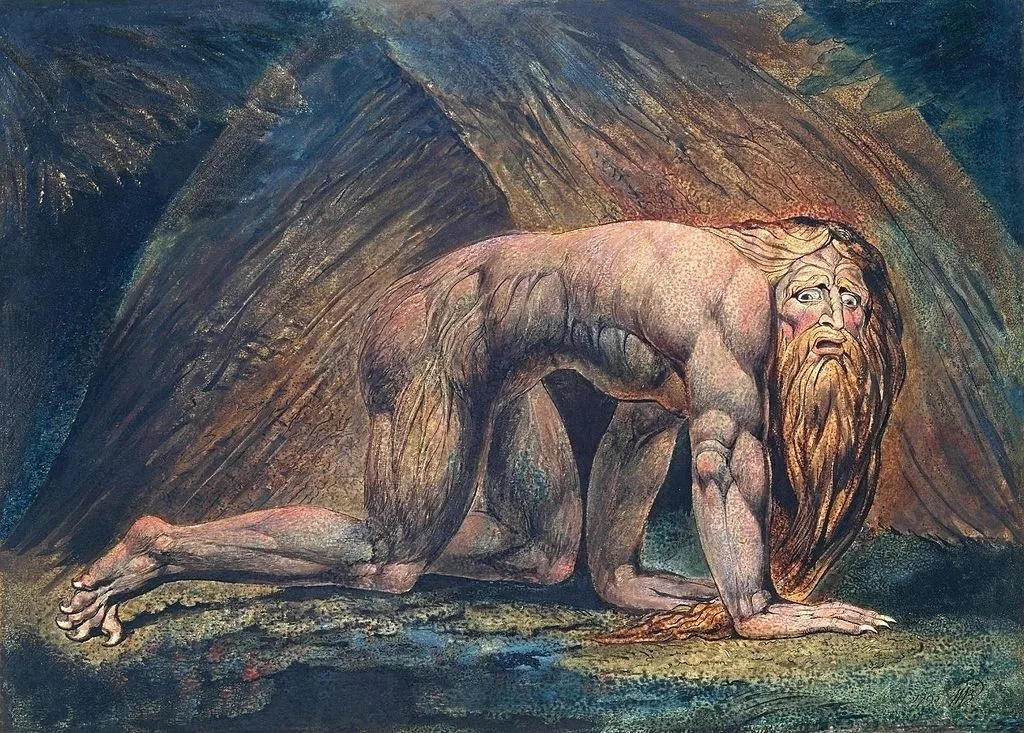
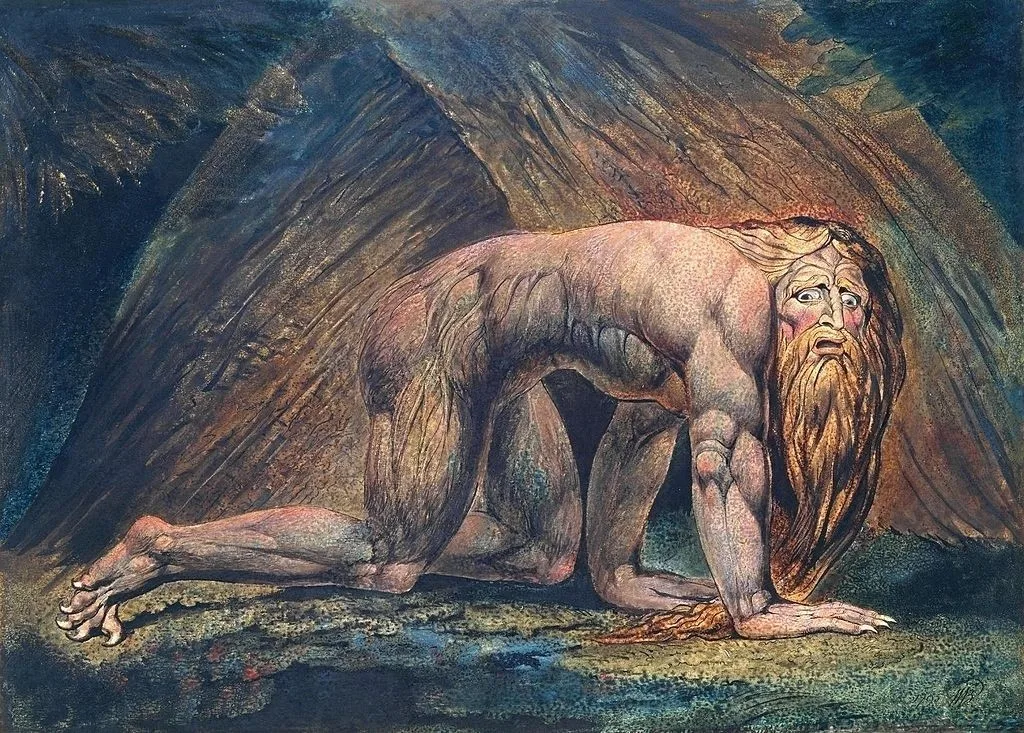
‘Nebuchadnezzar’, William Blake, 1795-c.1805
“They fear their higher self because, when it speaks, it speaks demandingly,” wrote Nietzche. [2] Most of us know that the fruits of success can only be attained through hard work, pain and suffering. Upon such a call, we’re left with a decision to make: we can either continue to go down on the path of mediocrity that would only add more frustration and misery into our lives, or we could choose to encounter all the possible obstacles that may lie ahead of us in the pursuit of a more noble life. Whilst inspiration is great to spark the flame of a better life, it is the ambition that will keep the ball rolling. Steven Pressfield defines ambition like this:
“Ambition, I have come to believe, is the most primal and sacred fundament of our being. To feel ambition and to act upon it is to embrace the unique calling of our souls. Not to act upon that ambition is to turn our backs on ourselves and on the reason of our existence.”[3]
So, is that it, then? Is the lack of ambition the only thing holding us back from living the life we want to live? Times come when we finally start taking steps towards heeding the call from our higher self. We finally find the determination and the ambition to move forward, yet we still feel a great force acting upon us and pulling us back. That force is Resistance.[4] We once again turn to Steven Pressfield for his wisdom on Resistance:
“Most of us have two lives. The life that we live, and the unlived life within us. Between the two stands Resistance.”[4]
As I have mentioned before, resistance comes in all forms and is all around us. It is a force that is disguised so well that we don’t even become aware of the fact that we’re facing it. Resistance manifests itself in many ways. We rationalise excuses, and we even start to believe them ourselves. However, hiding behind excuses only leads to more frustration and misery, because deep down we know that there’s so much potential within us that remains unfulfilled. Sometimes the frustration, which is born from ignoring the call of our higher self, can reach new heights such as depression, anxiety and the tendency to self-medicate.[5] As we move forward to fulfil greater possibilities, a feeling of fear emerges, which is nothing but a manifestation of Resistance. While fear is a healthy way of responding to threats of danger, it can also be an unhealthy response to our highest potentials. The fear of becoming greater than what we already are intensifies so much that we engage in behaviours of self-sabotage and try to eliminate all the possibilities of a greater life through destruction.
Abraham Maslow shared his insights on fear; “We fear our highest possibilities…We are generally afraid to become that which we glimpse, in our most perfect moments, under the most perfect conditions, under the conditions of the greater change.”[6]
We must first understand that it is inevitable for one to face Resistance when making a shift from mediocrity to greatness. In the words of Thomas Merton, “What you fear is an indication of what you seek”.[7] If fear is just another form of Resistance, perhaps we could use it as a tool to understand our greatest desires. What would your life look like, if you could finally find the courage to attack your fears? What is it that intimidates you the most? What is your greatest desire, the one that leaves you paralysed in fear?
It should be understood that a fight with Resistance is not a one-time battle. According to Steven Pressfield, Resistance is an enemy within us, and we must re-commit every single day to combat it. [3]
“Resistance arises from within. It is self-generated and self-perpetuated. Resistance is the enemy within.”[4]
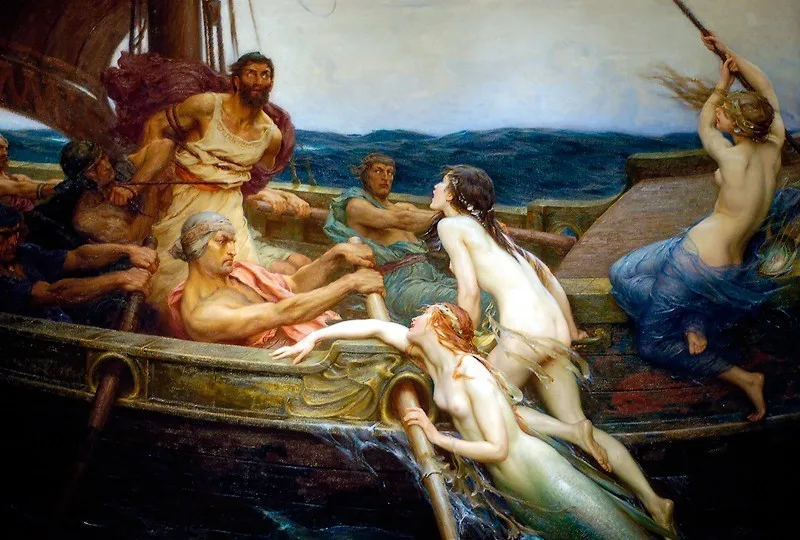
Ulysses and The Sirens, Herbert James Draper, 1909
If Resistance is the enemy within, then we must get to know our enemy better. We must understand the inner workings of its mind so that we know how to fight it. We can learn how to recognise our own set of psycho-behavioural patterns that are fuelled by Resistance, and try to stop ourselves from self-sabotaging. We must learn how to live with Resistance, as it is a part of human nature, and find ways to deal with it. We cannot sit around and wait for the fear to go away. Sometimes we must act despite the fear, keep moving forward despite the force pulling us back. I would like to end this essay with a mantra that I repeat to myself, whenever I feel I’m being sunk in the feelings of Resistance:
I fully acknowledge that Resistance is always going to be a part of my life because I’ll always be moving forward.
References
[1] Grc.nasa.gov. Newton's Third Law of Motion. https://www.grc.nasa.gov/www/k-12/airplane/newton3.html. (2021).
[2] Nietzche, F. Human, All Too Human. p.624. (1878).
[3] Pressfield, S. Turning Pro: Tap Your Inner Power and Create Your Life's Work. (2012).
[4] Pressfield, S. The War of Art: Break Through the Blocks and Win Your Inner Creative Battles. (2002).
[5] Delgado, J., Delgado, J. and Delgado, J. What is the resistance to change?. Psychology Spot. https://psychology-spot.com/resistance-to-change/. (2021).
[6] Maslow, A. The Farther Reaches of Human Nature. (1971).
[7] Merton, T. Journals: June 22, 1966, VI.332. (1996).
Photo: William Blake, Nebuchadnezzar, 1795-1800, Colour print, ink and watercolour on paper, 445 × 619 mm, Tate, London, UK.