

Folk Dance and Music in Greek- and Turkish-Cypriot Communities: After the Separation of Communities (III)
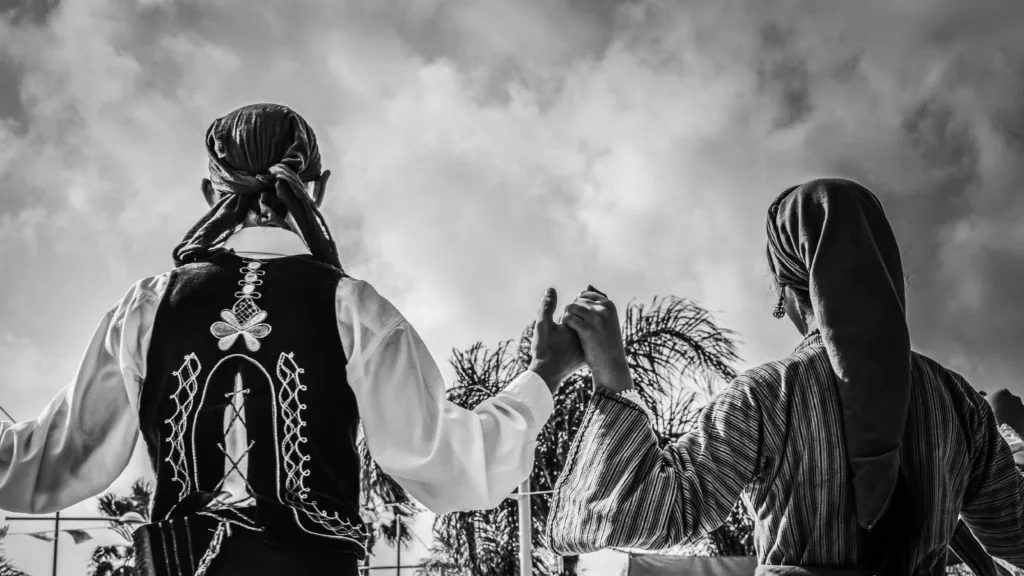
Continuing from the first two chapters, the third and final chapter of “Folk Dance and Music in Greek- and Turkish-Cypriot Communities” will discuss the period between 1974 and 2003 to understand the effect of political and socio-cultural factors on the journey of Cypriot folk tradition after the separation of Turkish- and Greek-Cypriots.
1974-2003: Some Trials to Ensure the Survival of Tradition
There were important political changes in 1974, which resulted in a physical and ethnic barrier between Turkish- and Greek-Cypriots. Initially, the armed coup d’état was the Greek military junta of 1967-1974 and the Greek Army in Cyprus.[1] Then, on 15 July 1974, this coup exiled President Makarios III and brought the Greek nationalist, Nikos Sampson on power for pro-Enosis.[1] Although the coupists wanted to establish the "Hellenic Republic of Cyprus", the United Nations (UN) saw this movement as illegal, which disrupted human rights laws.[2] Following this, the Turkish invasion of Cyprus on the 20th of July led to the displacement of populations. The physical barrier had resulted in the buffer zone which is also called "Green Line" or "Dead Zone".[3] This barrier is being protected by the UN. Approximately, 160,000 Greek-Cypriots moved to the south of Cyprus, and roughly 50,000 Turkish-Cypriots moved to the north.[3] Although many national political forces contributed to the change of the folklore of Cyprus, and the physical barrier is an extension to this, Cypriot folk music and dance did not change; indeed, there were also many attempts to further the Cypriot folk tradition.
After 1974, some important social forces, particularly the Turkish- and Greek-Cypriot Left, started an alternative type of nationalism to propagandise the similarities between both Cypriot sides; amongst some people, there were also varied differences between language, ethnicity and culture to a certain extent.[4] However, these people particularly focused on the similarities of Cypriots rather than the differences. According to Tsangaridou, "Yet, despite the lack of contact, elements of the common Cypriot repertoire discussed... lived on and even flourished within each community individually."[3] This was done by the bi-communal events, which were arranged with the aid of the international forces. For instance, a bi-communal dance ensemble, Steps for Peace, was established in 2001.[3] The number of members of the ensemble increased over time, and they also extensively performed around Cyprus. The songs are still sung in both Greek and Turkish languages. The musicians and dance groups from both sides were requested to perform abroad together.[4] Thus, many developments were apparent for the survival of the combined Cypriot folk tradition without any changes in music and dances.
Moreover, Greek Cypriots asserted a type of study about the history of the country to illustrate the notion of "peaceful coexistence".[5] This notion demonstrated that the Greek- and Turkish-Cypriots lived together for centuries, and they are able to do it again; they put forward their suggestions that the islanders should be reunited again. The political views of the historians were crucial as they showed examples of how both communities were friends: attending each other’s weddings, performing folk dance and music together, and doing more of the everyday shared activities.[5] However, most of the Greek Cypriots were unable to speak Turkish; therefore, they had difficulties in translating their language to Turkish-Cypriots. These propagandas and consciousness of one’s Cypriotness resulted in more focus on Cypriot folklore studies to continue the tradition which, to a certain extent, existed before the 1960s’ conflicts.
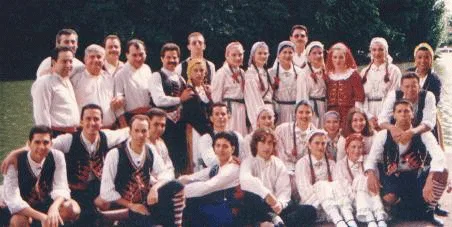
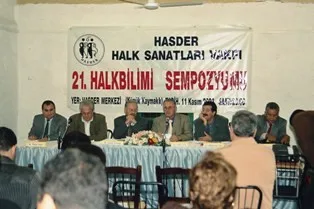
Turkish-Cypriots also forwarded some ideas on this type of Left nationalism and their type of exemplary model was the folklore studies. The fundamental question asked by Papakadis and Hatay was, "to whom does the coffee belong? (Is it Greek/ Byzantine, Turkish/ Ottoman or really Arabic?)."[5] As with the questions of coffee, the same questions were asked to folk music and dance during this period. The sense of belonging was quite strong when considering the Cypriot folklore, where people felt a sense of ownership of the Cypriot folklore because it was part of their sense of belonging to the country. Accordingly, the Turkish-Cypriots started to search. During the 1980s, Kani Kanol founded Halk Sanatları Derneği (HAS-DER) (Folk Arts Association) which was directly associated with the Left’s political ideas (Appendix 1).[6] HAS-DER also issued a magazine to publish about the Cypriot folklore and organised a yearly symposium on its studies (Appendix 2). They are still frequently performing around Cyprus and abroad. The preface from the first published writing states:
"If we accept... that the culture which existed on the island before the Ottomans took Cyprus influenced the Turks who settled there in 1571 and that the culture which the Turks who came from Anatolia brought with them influenced one of the island’s communities, then we can say that two people have folk cultures which include both similarities and differences. It is the duty of contemporary folklorists to stay away from chauvinist feelings... arguing that ‘this is ours, this isn’t or searching for a 'pure culture'... brings to a community not good but harm..."[7]
Thus, after 1974, it was the time of realising that Turkish-Cypriots had their own Cypriot folk culture, whether it was similar or different from Turkey's. Turkish-Cypriots’ religion, language and ethnicity were different from Greek-Cypriots’, but folk music and dances were not, and they were still shared between two communities after 1974; the focus on folklore was even more apparent.[4] As Azgın and Papadakis stated, "...folklorists were not just engaged in a study of culture in the past; they were equally shaping the culture of the present, through their selection of what should be preserved and transmitted, especially in education, and in the fields of dance, music and language."[4] Therefore, it may have been understood by the Cypriot public that the trials were, on the surface, representing Cypriot folk music and dance culture even after the partition borders were constructed.
Nevertheless, there was still some loathing present following the events on both sides, and the destruction of social networks disabled the communication and transmission of the Cypriot repertoire. Both communities brought their TV programs from Greece and Turkey.[8] The Greek-Cypriot’s National Curriculum determined the "official" cultural facilities, such as Greek music and dances, for Greek-Cypriots to learn at schools. Some school teachers brought Greek folklore studies from Greece and by 1975, the ancient idea of "an idealized peasant-romantic Cyprus" was evident.[9] This meant that national notions tried to disturb the existence of the folk culture. Hence, there were still endeavours in losing the Cypriot folk tradition.[9] It was also seen that, in the 1980s, many dance groups appeared to teach the Cypriot folklore to the Greek-Cypriot community by being unconscious about its bi-communal traits.[9] Indeed, the folk tradition survived both consciously and unconsciously after 1974 in both Cypriot communities, but only to a certain extent.
Whilst discussing some of the forces that ensured the survival of this folk tradition, it is also important to consider the socio-cultural changes in the tradition. Indeed, life was changing as the Cypriots were separated, and so was the tradition.[4] For example, folk music and dance used to be so popular to be played at weddings. However, as technological developments took place, the use of radios became a trend. As people heard contemporary Greek, Turkish and English popular music during the 1980s, interest in this kind of music flourished. Rapidly, pop music took folk music’s place in weddings, and "only a few hours" of folk music and dance was performed by both Cypriot communities.[4] Moreover, Turkish-Cypriots’ davul-zurna ensemble, which was differentiated from the Greek-Cypriot community before 1974, was rarely seen in the tradition after the 1980s; they were mostly seen in circumcision ceremonies.[4] In terms of musicians, performers who played in ensembles started to learn the repertoire at music conservatories instead of from their masters. Folk dances also voyaged from the village areas to the concert stages in towns.[4] As Azgın stated, "In a word, Turkish-Cypriot folk music and folk dances have come to look like artefacts in a museum."[4] Although the tradition had significantly faded to a major extent in a socio-cultural sense, folk music and dances stayed the same in both communities, and many efforts were also given to guarantee the tradition’s survival, as mentioned above.
In conclusion, folk dance and music tradition still continue in both Turkish- and Greek-Cypriot communities, but it is clearly seen that the tradition had evanesced to a great extent due to the nationalist movements during the events of 1960-1974. Through the political trials of Turkifying and Hellenizing the Cypriot culture by enosis, TMT, and many other forces, displacement of people, and cultural and social destruction of the country acted negatively on the modes of broadcast. After 1974, radio as a technological development brought popular music to the island, which was another greatly entangled socio-cultural factor in the fading of the tradition. Although the repertoire of folk dances and music was not revolutionized, there were social changes in the tradition, such as the occasions where the music and dances were played: mostly in festivals and sometimes weddings. Indeed, there were evidently bi-communal and also individual associations, which contributed to the survival of the folklore to some extent, such as HAS-DER and Steps for Peace. Folk music and dances were and still are a shared culture between the Cypriot communities, whether one considers themselves as Turkish-or Greek-Cypriot, Turkish, or Greek. Overall, although the tradition has mostly disappeared from the island, many efforts have also been made to continue the Cypriot folk dances and music tradition despite the effects of nationalism in the country.
APPENDIX
Appendix 1. Picture of HAS-DER in 2001. Taken from HASDER [Folk Arts Association], ‘Folk Arts Foundation’ (2009).
Appendix 2. 24th Folklore Symposium of HAS-DER. Taken from HASDER [Folk Arts Association], ‘Folk Arts Foundation’ (2009).
References
[1] Mallinson, W. Cyprus: A Modern History. (I. B. Tauris, 2005).
[2] Allcock, J. B. Border and Territorial Disputes. (Longman Group, 1992).
[3] Tsangardiou, E. One Music, Two Labels. Music in Cyprus. ed. by Jim Samson and Nicoletta Demetriou. 37-56. (Ashgate Publishing Limited, 2015).
[4] Azgın, B. Transforming Culture: Traditional Music and the Turkish Cypriots. Music in Cyprus. Ed. by Jim Samson and Nicoletta Demetriou. 77-88. (Ashgate Publishing Limited, 2015).
[5] Papadakis, Y. and Hatay, M. The Cultures of Partition and the Partition of Cultures. Music in Cyprus. ed. Jim Samson and Nicoletta Demetriou. 19-36. (Ashgate Publishing Limited, 2015).
[6] Kanol, K. Kibris Halk Danslarinin Yakin Gecmisi (The Recent Past of Cypriot Folk Dances). (HASDER Yayinlari, 2006).
[7] HAS-DER. Halkbilim Sempozyumlari (Folklore Symposiums). (Gumus Basimevi, 1986).
[8] Garanti, S. Kıbrıs Havaları [Cyprus Music]. Motif Akademi Halk Bilimi Dergisi. 327-332. (2013).
[9] Demetriou, N. Appropriating Culture: Traditonal Music and the Greek Cypriots. Music in Cyprus. ed. Jim Samson and Nicoletta Demetriou. 57-76. (Ashgate Publishing Limited, 2015).
Photo: PxHere, CC0 Public Domain.