

What Can a Shampoo Advertisement Tell Us About Past and Present Gender Stereotypes for Women?

Introduction
Lustre-Creme is an American shampoo brand which targets young women as their main audience. The poster advertisement above is from the late 1960s, and has resurfaced lately on social media, being labelled as “sexist” and “stereotyping”. This article examines elements of the poster in social and historical context in order to reveal the stereotypical messages it might have given to the women of the 1960s, and whether this would be considered appropriate today.
Lustre-Creme was a branch of the Colgate-Palmolive company: an American multinational consumer products company mainly specialising in the production, distribution and provision of household, healthcare, personal care and veterinary products. Their first-ever product, a lanolin-based shampoo launched in 1944, is on display at the Smithsonian National History museum in the USA.[1] They are also well-known for having Hollywood’s icons at the time in their advertisements. Some popular names include Marilyn Monroe, Betty Hutton, Janet Leigh, Sandra Dee, Joan Crawford, Elizabeth Taylor and Doris Day. Although there is no data available about the market success of the brand in the 1960s, we can infer it performed well during this time period, since it remained in the market until the late 1980s. So, the advertisements were somewhat impactful.
These advertisements were at the height of their popularity in the 1960s, which was an era when civil and social rights were improving around the world, especially in the USA; an era of modernisation for women. The second wave of the women’s liberation movement was happening, and it had become more socially acceptable to dress less conservatively and have more freedom of choice. This idea was being promoted widely in the media too. The NOW (National Organization for Women) had been established as a pressure group which protested against and drafted bills for various matters such as abortion rights, banning employment discrimination, maternity leave rights and unsegregated education.[2]
The traditional, home-bound stereotypical role of women was also being challenged vastly. In her best-selling book, The Feminine Mystique[3], Betty Friedan outlines that “women who had been told that they had it all – nice houses, lovely children, responsible husbands – had been deadened by domesticity, and were too socially conditioned to recognize their own desperation”. This was an era of realisation for women; a wake-up call about how their stereotypical stay-at-home were roles imposed onto them, understanding that they should have a freedom of choice about the path they decide to take in life, and voicing their dissatisfaction with roles forced onto them.
The poster in historical context: an analysis of the visuals
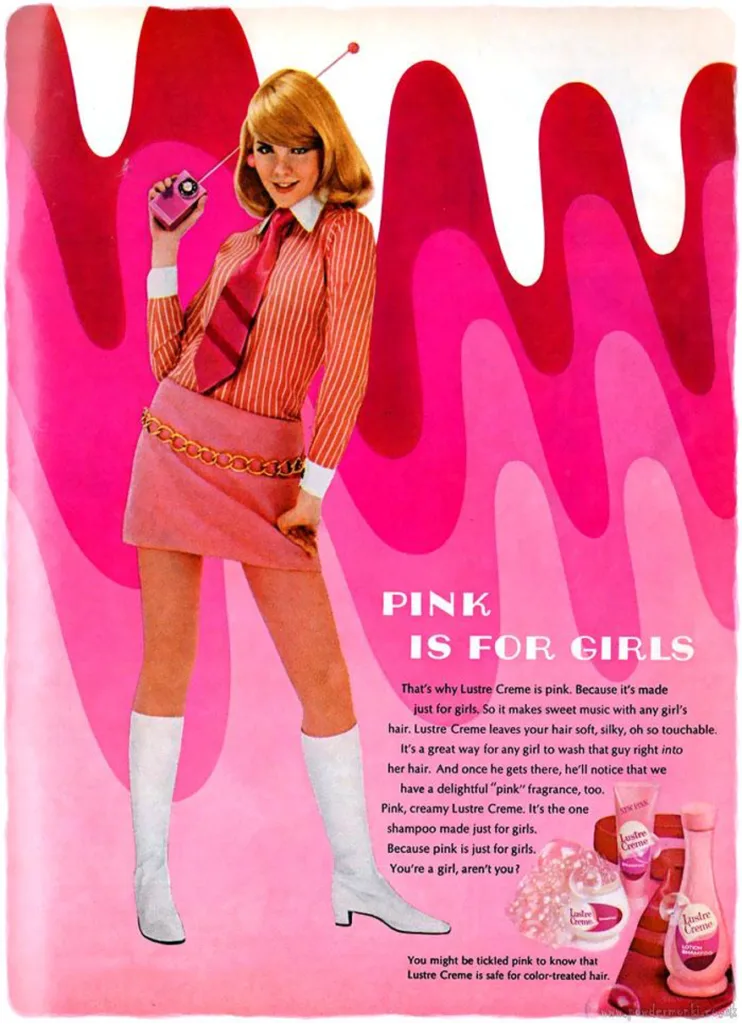
The geometrics of the poster relate to the psychedelic movement of the 1960s, when colours and patterns like those on the poster were favoured by young Americans. There are many different shades of pink; from magenta to rose, fuchsia to hot pink. Besides, there is also some red and white. Romantic and seductive colours such as pink and red are denser in ratio when compared with white, which is symbolic of innocence. Instantly, we can infer that the poster focuses on a seductive physical perception of a woman.
Due to the absence of a title, we can deduce that the poster relies on the vibrant colours and the images to attract consumers. It seems that the producers want the colour pink to stay in people’s minds, more than the name of the product. By doing this, they further promote the common stereotype that women in society should be fond of the colour pink. Standing in a cascade of pink is the image of a woman. She too is a part of the pink colour scheme, as the colours in the background are echoed in her clothing. The high concentration of pink and the lack of variety in terms of colours suggests that the poster is almost saying that there is one type of woman in society. There is no room for diverse interests, just like there was barely any room for women having different societal roles apart from being housewives.
However, this was a time when a move away from traditions had begun. For example, in September 1968, around the same time this Lustre-Creme poster came out, women were protesting the image of womanhood conveyed by the “Miss America Pageant.”[5] The appearance-oriented stereotype of women being promoted by the pageant, which is also present in this poster, and also sexist nature of the pageant itself, were being protested.
In the short paragraph on the bottom right corner of the poster, it is written in a declarative tone, and repeated multiple times, that “pink is just for girls.” Within the description, full stops and short, fragmented sentences are used often, creating longer pauses that are more dramatic and impactful. This is a methodical approach that links in with the colour scheme and stereotypical message of the poster, to assert that there should not be any questions regarding the power of the product and that the information provided is implicit. Pink being for women is stated in such a way that it seems like a logical fact, not to be questioned.
Additionally, the woman is wearing an absurd match-up of clothes; a formal looking shirt, a thick tie and a miniskirt, which were fashionable clothes in the 1960s. The short skirt is informal and arguably a choice of clothing that sexualizes the woman – but, at the same time – the formal clothing she wears on top suggests work attire. In essence, the white cuffs and pinstripe make the shirt seem like one a high-powered businessperson or lawyer would wear to work. Perhaps this could be symbolising the fact that women can have a multifunctional role in society, that goes beyond their traditional role at home, thus empowering them. But then again, any suggestion of empowerment is overshadowed by the clashing stereotypical messages which are also being put forth.
A portable transistor radio, which had just become the most popular electronic communication device in the 1960s and 70s, is in the woman’s hand.[6] As a symbol of modern life, these devices were owned by most middle-class and upper-class teenagers or young adults in the USA at the time. Its presence in the poster suggests that women who own a radio and listen to the latest music are followers of the latest trends in society. Thus, it is stated that a modern woman who listens to the newest music is the kind of woman who should be attracted to this shampoo.
Also, there is something authoritative about the way the woman in the poster holds the radio. She appears to be a woman who knows what she wants and is not afraid to get it – she is not someone passive but rather a decision-maker, a go-getter. This complements the fact that she is looking straight at her audience; confidently and provocatively. Hence, this portrayal could be symbolic of its time: a time when more women were becoming their own leaders.
Presumably the most controversial part of the poster is how it conveys that as a young woman, it is almost an achievement to be noticed by a man. By the statement that Lustre-Creme is a “great way for any girl to wash that guy right into her hair”, it is implied that one of the main motives behind a woman wanting her hair to look good and smell nice is to attract a man. This portrays young women in society as people who require the validation of a man to feel attractive. This contradicts the confident and dominant look of the woman on the poster, as it is highly unlikely for someone who constantly needs validation to be truly confident. In a way, the advertisement normalises a very unhealthy way of feeling (temporarily) confident. Why not encourage women to be self-maintaining and to love themselves? If one cannot be their own source of confidence, are they ever truly confident? So, the bold and self-assured figure depicted in the poster is, in fact, the opposite of what it seems to be. Rather, she is an emotionally dependent person, who does not see her attractiveness unless a man mentions it to her. Therefore, all possibility of there being an empowering meaning to the poster is shattered.
Consequently, this advertisement asserts the message that a woman should desire to be attractive in order to attract a man, which is not only sexist but also stereotypical of the archaic perceptions of a woman’s role in life. It also generalises all young women as seductive, and “pink-loving” beings, trying to fit them all into a single stereotype and interfering with their freedom of choice and individuality. Despite the fact that the poster visually presents a modern, forthcoming woman who has a dominant and confident stance, the suggestion that her confidence is fuelled by the validation she gets from men overshadows the possible woman empowerment that might have been attempted.
Some final thoughts
The Lustre-Creme brand no longer exists. However, if it still did, and they used the same advertisement method giving the same message about women today, they would definitely receive more backlash and negative comments from the public. This is due to the increased action and awareness towards banishing gender stereotypes in our societies (even though there is still considerable room for improvement). Moreover, nowadays we are able to be more expressive and outspoken towards sexist stereotyping and discrimination, through the multiple platforms available to us. A prime example of one of these platforms is social media – it encourages free self-expression and allows all of us to react collectively to matters. Through social media, we can easily share issues of global importance with numerous people, and the more people we share it with, the more robust a reaction we can generate towards sexism and stereotyping disguised in things we come across in our everyday lives, such as advertisements.
As time evolves, so do we, breaking constrictive social barriers as we do. Slowly but surely, we are freeing ourselves from stereotypes, and are becoming more open-minded in how we view each other. This is a result of our growing recognition of the idea that none of us have to be what society tells us to be, because the value of our existence is not to be defined by how well we “fit in”. The advertisement resurfacing as something controversial is an indicator of our progress in this area – stereotyping that seems completely inappropriate to us today, was considered normal or tolerable around 60 years ago.
Abolishing stereotypes is one of the most important steps to take in order to be able to reach equality, not only for women, but for all social groups. With respect, acceptance, solidarity, and the access we have to platforms through which we can make ourselves heard, taking this step this seems an achievable goal.
References
[1] Smithsonian. Lustre-Creme Shampoo with Lanolin, https://www.si.edu/object/nmah_1448905.
[2] Burkett, E. Women's rights movement. Britannica https://www.britannica.com/event/womens-movement (1998).
[3] Friedan, B. The Feminine Mystique. (New York: W.W. Norton, 2013).
[4] Retro Musings. LUSTRE CREME ~ HAIR CARE ADVERTS [1967-1968] “PINK IS FOR GIRLS”. https://www.ghostofthedoll.co.uk/retromusings/lustre-creme-hair-care-adverts-1967-1968-pink-is-for-girls/.
[5] Gay, R. Fifty Years Ago, Protesters Took on the Miss America Pageant and Electrified the Feminist Movement, Smithsonian Magazine https://www.smithsonianmag.com/history/fifty-years-ago-protestors-took-on-miss-america-pageant-electrified-feminist-movement-180967504/ (2018).
[6] Smith, C. How the transistor radio changed the world, BT https://home.bt.com/tech-gadgets/internet/retro-tech-the-transistor-radio-11363937910884 (2018).
Photo: Mohamed Hassan, Pixabay