
Abraham Lincoln once described democracy as “government of the people, by the people and for the people” which implies that democracy is a form of government that includes the element of people in the formulation of governing.[1] Democracy can take various forms such as; classical democracy, liberal democracy, social democracy, etc. However, what makes democracy distinct from other forms of government is its functionality that operates with the factor called "demos", meaning people. Among these different forms of democracy, the one which is the most and widely popular is liberal democracy. Having its roots in the ideology of liberalism, liberal democracy operates as a system of representative government where the power of this government is limited and puts the individual and individual’s rights and liberties at its centre of focus.[2] From my perspective, liberal democracy, as emerged from liberal thought, gave way to the rise of the individual by creating a type of government protecting its rights and liberties while diminishing the power of the state by limiting its extent of authority.
To start with the emergence of liberal democracy, it is necessary to first examine the emergence of liberal thought. The roots of liberal thought lie in the ideas of Reformation as it gave way to a kind of autonomy in the individual by referring to an individual’s ability to worship without the Church as an intermediary. This claim at first leads to a reduction in the authority of the Church as an institution against the individual, giving individuals space to act freely.[3] This can be considered as a starting point for the individual to become an actor in the social life independent, at first, from the Church, and then from the state. One of the most important liberal thinkers, John Locke has discussed the right to life, liberty, and property – or estate – which gave way to the exercise of these rights by a new actor in the society: no doubt, the individual. These liberal notions of rights and liberties can be seen as a first step to reduce the state's power and control over individuals and take them out of the state sphere in order to free from the government.[4] Moreover, in the political realm, individuals are to be governed by a state led by their representatives who can be elected by people in regular elections, making them accountable to the individuals. This form of representative government driven by liberal notions resulted in a system where political liberty exists. Additionally, in this kind of liberal democracy, individuals are to enjoy economic rights and freedoms based on liberal notions, such as free enterprise with the right to private property and the existence of the free market. This free-market economy is for the benefit of the individual rather than the state as it was alike in pre-liberal state, such as mercantilism. All these factors ranging from political to economic are the main reasons that liberal democracy is for the individual whilst being against the state.
Furthermore, liberal democracy creates a system where the power of the state over the individual is limited by weakening its sovereignty, especially at the internal level which can occur in two ways. First of all, by political means, as the state gives more and more autonomy to the individual in the political and social realm, its extent of power and authority start to diminish. This happens because the individual becomes less and less dependent on the state in liberal democracies where liberal principles apply and become freer compared to what it used to be. For instance, the rule of law is one of the most basic principles of liberal democracy that limits the power of the state to behave arbitrarily towards the individual.[3] In addition to that, by the introduction of freedom of faith or religion in liberal democracies, it is no longer the monarch that decides on the faith of the society but individuals themselves who choose what to believe. Secondly, by economic means, since the state is no more in charge of economic activity and its only duty is to oversee it rather than intervening, this directly reduces its sovereign power in the economic realm. In liberal democracies, individuals engage in economic activity for their benefits and interests rather than the state’s interest. Due to these two reasons, in liberal democracies where political and economic liberal principles apply, the diminishing power of the state can not be ignored.
In conclusion, given the current global population and dispersed settlements of people, it is almost impossible to govern modern societies with direct democracy. This leads to the evolvement of representative democracy in different forms; one being liberal democracy which, from my perspective, is the best and the most sustainable one. Emerged from the liberal thought and absorbed principles and elements of it, liberal democracy is the model that gives the individual to be free and equal in a given society by escaping from the constraints of government to rise. The way a liberal democracy is established protects the individuals from the state, gives them a say in the government, and secures their rights and liberties by rule of law. In my view, with recognising equality and liberty and by increasing the voice of the individual in the political and economic realm, liberal democracy is a model which is absolutely for the benefit of the individual while being against the state.
References
[1] Heywood, A. Politics. (Palgrave Macmillan, 2013).
[2] Hague, R., Harrop, M., and McCormick, J. Comparative Government and Politics. (Palgrave, 2016).
[3] Held, D. Models of Democracy. (Stanford University Press, 2006).
[4] Ball, T., Dagger, R., and O’Neill., D. I. Political Ideologies and the Democratic Ideal. (Taylor & Francis, 2016).
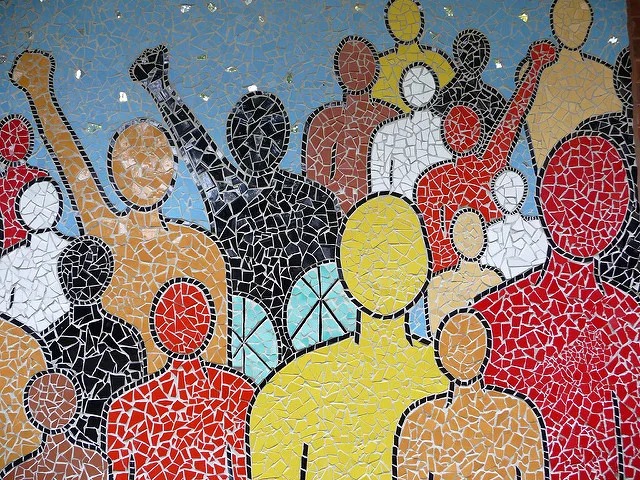
Photo: People Power Mosaic, Herb Neufeld, CC BY 2.0.