

The nude, especially female nude, has always been a popular concept with the most focus seen during the Renaissance in Western art. The nude is not merely the state of nakedness but, as Lynda Nead explains, “nudity transcends that historical and social existence, and is a kind of cultural disguise."[1] She also defines the nude as “a picture for men to look at in which Woman is constructed as an object of somebody else’s desire” in T.J. Clark’s words. This statement echoes Rozsika Parker and Griselda Pollock’s famous view that “women are simply the scenery onto which men project their narcissistic fantasies."[2]
Accessing the Unachievable
The female nude appears to be a way of escape for both the artist and the viewer. Freud viewed the artist (who was often male) as “a near-neurotic whose instincts impel him to seek fame and fortune, honour, power and the love of women, but who lacked the ability to attain these goals."[3] This failure leads them to express their desires (often sexual) “in creating fantasies."[3] Frequently, the paintings are made for another which means the pictures are as representative of the aimed audience as of the painter. Most paintings before the 19th century with an attractive female figure seems to have an important, mythological, and unachievable woman illustrated like Venus, Madonna, queens and nymphs. It only signifies the failure of men and their hidden desires of power. Venus, especially, is an essential figure in arts, as the perfect woman since she is “the goddess of love, beauty and sexuality"[4]; in Sebastian Goth’s words, “a multifaceted figure of the creative, of the birth and beauty of form in Western culture."[4] As a goddess representing these qualities, she is the quintessence of feminine beauty and sexuality. Therefore, she is easy to frame as a woman to apply male desires to.
Parker and Pollock claims “[t]he female figures are frequently asleep, unconscious or unconcerned with mortal things, and such devices allow undisturbed and voyeuristic enjoyment of female form".[2] They also use words like “passive, available, possessable, powerless"[2] to describe the representation of women in nude paintings. Although women mostly being unconscious is not entirely accurate, and many famous paintings have conscious female characters, even almost seducive women, it is agreeable that the unconsciousness of the women may make it easier to empose the fantasy of possession onto them. The state of being asleep or awake also shows the viewer the type of sexual desires the artist has. Sleeping Venus by Giorgione (Fig. 1) and Titian is one example of a possessable Venus figure depiction, open to applications of narcissistic desires.
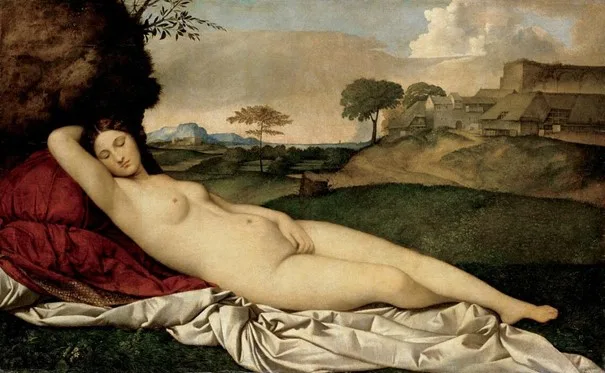
The way the body is positioned, with one of her hands behind her head, allows a full view of the breasts and the body. The softly and carelessly placed hand over her sexual organ draws attention to her sexuality, creates a sense of mystery and yet still looks easily accessible. Instead of coverage, the hand looks like a fallen leaf, which can easily be removed to reveal what is underneath. The sheets which Venus lies on seem quite realistic, with the creases and the shading, the texture looks almost satin-like which does not only make it seem more real but also gives a sense of quality and class. This helps to convey the feeling of reality of Venus and her perfect body, as well as her of a higher status adding to the fantasy of self-importance of the male. Realistically, at the time, the kind of women would be available to men, (apart from their wives) would be prostitutes – low class women –, where is here, they have access to a goddess, a woman of high status, which is the type of women they believe to deserve. Darker shades used for the background compliments the fairness of her body giving the feeling of purity, as well as showing us the value of whiteness in 16th century Europe. The clouds and the sky also appear to be polluted (unless it was due to damage over time) and even her hair is darker than most depictions where her hair is blonde, golden or light brown. This brings all the attention to the body and avoids any distractions. The tranquillity of the surrounding and the peaceful facial expression of the goddess sleeping adds to the impression of no resistance. The absence of any other living creature present gives a feeling of privacy and gives the notion of this view being only for the eyes of the viewer.
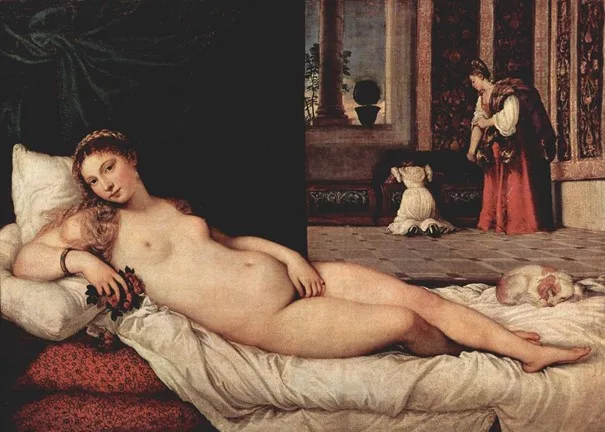
Although Sleeping Venus is attributed to Giorgione, however, was completed by Titian after Giorgione’s death. Therefore, it is not certain which part was painted by whom and whose fantasies this painting represents. Nevertheless, this painting resembles another painting by Titian, Venus of Urbino (Fig. 2) which again illustrates Venus. The hand gesture over the sexual organ and the colour contrasts in both of the paintings appear to be similar (although Venus’s hair in Venus of Urbino is fairer) which, thus, these features of Sleeping Venus may be attributed to Titian. However, the most significant difference between the two paintings seems to be the awakeness of Venus in Venus of Urbino, almost flirting with the viewer/artist. It might be discussed that Giorgione had a taste for passive women, whereas Titian liked to be seduced, to be offered, rather than taking; in other words had the desire for “bountiful, sexually generous women"[5], although there is no real evidence to support this claim.
Male Gaze
The gaze is what gives the meaning to a posture and a nude. This includes both the viewer’s gaze, intended to be the male gaze in classical paintings, and the women’s view of themselves. John Berger puts forth that “[m]en look at women. Women watch themselves being looked at"[6] and he also adds that “she turns herself into an object […]: a sight."[6] In the baroque painting, Rokeby Venus by Diego Velázquez (Fig. 3) we see Venus’s back turned to the audience, which is different from Renaissance art. She is looking into a mirror, a symbol of vanity, and is not concerned with meeting the gaze of the viewer. However, as Berger says, “[t]he real function of the mirror was […] to make the woman connive in treating herself as […] a sight"[6] and of course, is a way for the woman to survey herself as she is expected to look in a certain way. Although the face in the mirror is blurry, the facial expression does not seem to be constructed in any way; by contrast, the way the body is situated reveals curves and is postured erotically. Venus seems to be aware of being watched and lets herself being watched, although she does not turn her front to give a full view or enjoy the company. In Berger’s words, “[w]omen are there to feed an appetite, not to have any of their own. […] She is offering up her femininity as the surveyed."[6] Perhaps, the mirror is helping her make sure she has the right posture and that she is satisfying the viewer. The fact that Cupid, the god of love (who is Venus’s son) is holding the mirror might be interpreted as guidance for being loved as “[h]er own sense of being in herself is supplanted by a sense of being appreciated as herself by another."[6]
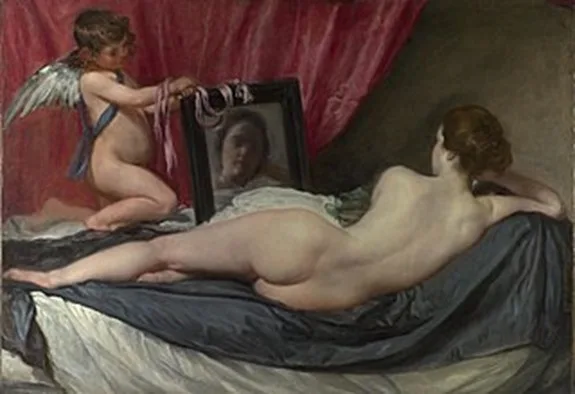
Interestingly, although this painting is not like the traditional nude paintings and does not show any breasts or female genitals but only the back of the female figure when the painting was first bought by The National Gallery, the media described the painting as “perhaps the finest painting of the nude world."[1] This could be because the painting was commissioned by a womaniser, Gaspar Méndez de Haro and that the figure depicted was Venus, the goddess of beauty and sexuality that made it seem more erotic than it appears to be. The sexual context of this painting mostly comes from external imposition, more than an initial erotic intention by the artist. This painting is mostly known for Mary Richardson’s physical attack on the painting in 1914, as an act of protest against the way women were treated. When explaining why she targeted Velázquez’s painting, she said, “I didn’t like the way men visitors to the gallery gaped at it all day."[1] Rokeby’s Venus (as the painting has the name of its previous owner) becoming public property may have made it appear to Richardson as the figure depicted in the painting being downgraded from a Goddess to a prostitute.
Male Nude
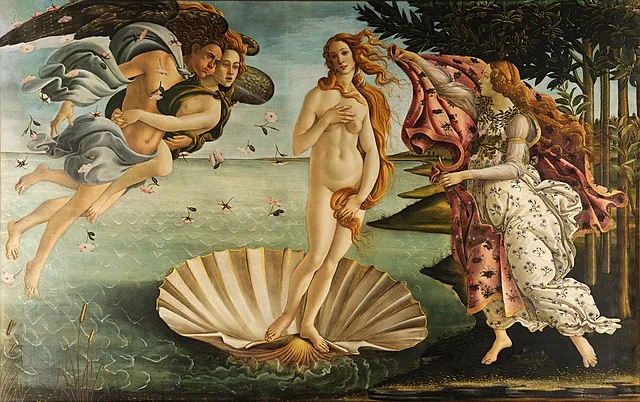
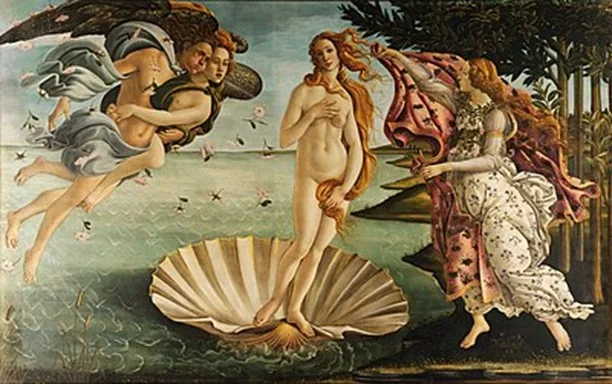
On the other hand, perhaps, not all nude art represent men’s self-centred fantasies in the same way. Botticelli's The Birth of Venus (Fig. 4) looks different than the other paintings mentioned here. Colours used are vibrant, and the background is not darker than Venus figure. There is more action going on, and there are three more characters in addition to Venus. Nevertheless, positioned in the middle, with other characters paying attention to her and even the waves in the sea pointing to her, Venus is still the centre of attention. She is still pictured beautifully with her perfect body and long golden hair. However, the way she covers her breasts and genitalia does not appear to be coyish, and we see a Horae (the woman figure on the right) coming to cloak her. Surely, there would be men finding this erotic enough with Aura’s (the woman figure on the left) left breasts showing and the overall nakedness of Venus. It might even be a privilege to have the first glimpse of the beautiful goddess (as this was when she was born). As Ronald Lightbown states, as well, there is a “celebration of woman’s beauty",[7] but this celebration “is almost impersonal."[7]
The painter, Botticelli never married, and Messer Tommaso came to a conclusion about him “that he was not fit ground for planting vines."[7] Although what he means here is ambiguous, the interpretations would come down to two possibilities: either he was infertile, or gay. Parker and Pollock talk about fantasies of men coming from their internalised fears, from a Freudian perspective:
A world which revolves on a phallic axis constructs its fears and fantasies in its own phallic image. In the drama of male castration complex, as Freud discovered, women are no more than puppets; their significance lies purely in their lack of penis and their star turn is to symbolize the castration which men fear.[2]
Venus is believed to be born from the foam which gathered about the mutilated genitals of Uranus. Her Greek name, Aphrodite, means foam-born which supports this belief. Choice of Venus, the goddess of fertility created from mutilated genitals (infertility), could be a deliberate choice representing Botticelli’s hope. It is believed that roses were born with Venus, which is why they are the flowers of love, and the flowers coming with the wind might be seen as roses. Also, it is not only the birth of Venus that is depicted but her arrival to Cyprus where it is believed she brings the vegetation to life and makes the flowers blossom. Therefore, the birth of Venus and all the fertility that came with her, ironically, created out of castration of Uranus — infertility —, possibly carry a sense of optimism.
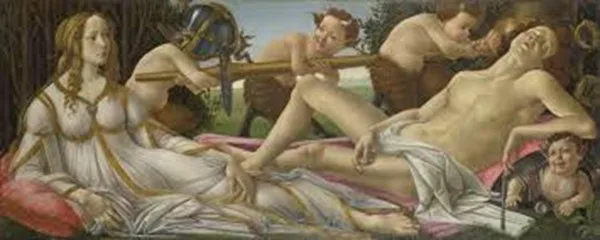
In the case of him being gay, this hope still applies, as he might have hoped he would have been able to take a wife, although a nightmare he had about having a wife said otherwise. It is notable that in the painting it is not only Venus who is naked, but also Zephyr (the male on the left) whose genitals are covered with his cloak surrounding him with the effect of the wind. This soft coverage and the sense of it almost being revealed has the same effect as the soft, teasing position of the hand in Sleeping Venus and Venus of Urbino so perhaps while putting the attention of the viewer to Venus, Botticelli was also picturing something for his own pleasure. It is also notable in Venus and Mars (Fig. 5), another one of his notable works, that Venus is dressed and Mars is naked with a small piece of clothing covering his sexual organ, as well as his hand positioned as Venus’s hand in female nude paintings. He is also asleep which might mean the applications of fantasies onto the male. Botticelli was once accused of keeping a boy in his house for sexual purposes which were never confirmed. If this was assumed to be accurate, it is possible that the nudity of Venus here was merely for storytelling purposes and that he was expected to participate in the nude art movement.
Reality Mocking Fantasies
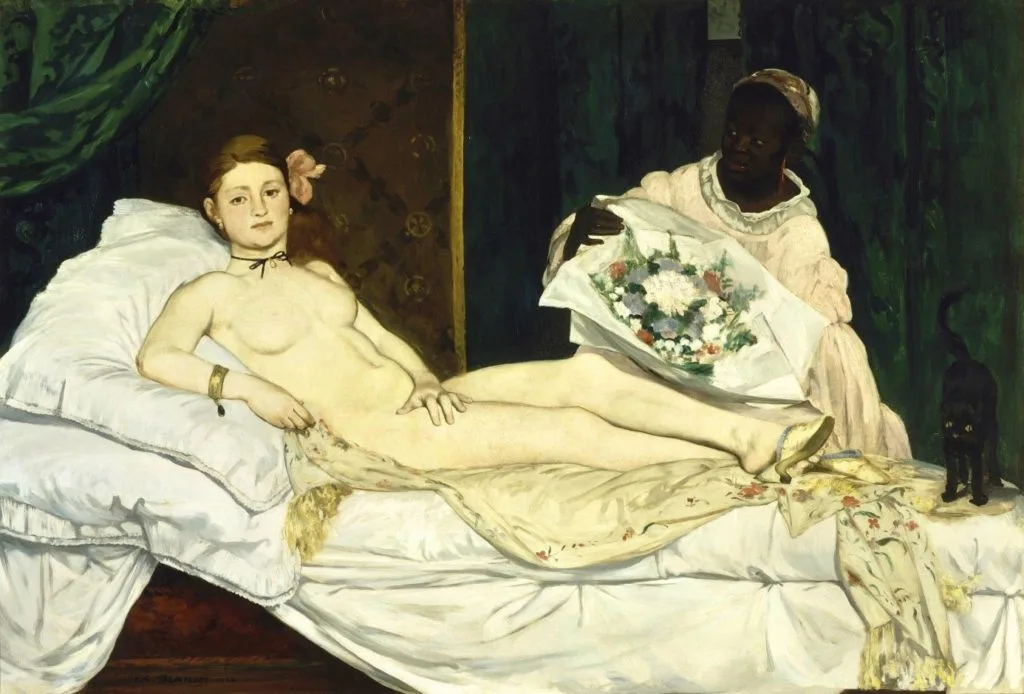
Olympia by Édouard Manet (Fig. 6) appears to be a wake-up call and maybe even a satire of the unrealistic fantasies of men. Manet who is a realistic painter moves away from depicting famous figures like Venus and even creates, what some might say, parody-like version of Titian’s Venus of Urbino (Fig. 2). Woman presented is a prostitute and, in contrast to Venus of Urbino, Olympia’s hand over her genitalia is more protective than inviting which, in a way, may present the idea of consent. Moreover, Olympia’s impression is more indifferent than seductive, and unlike Venus, she is wearing shoes which give the impression that she might walk away at any moment. Her body is still perfectly depicted and would be pleasurable for men to look at, but it brings in the reality that men get what they pay for and that the fantasy self-importance imposed on the paintings of unachievable women does not apply here; this is the kind of women they could have to satisfy their desires. The sleeping dog in Titian’s work which symbolises fidelity is replaced here with a black cat which looks like it might attack. This presents a wilder and dangerous atmosphere. The maids are also replaced with a black one, who possibly is a slave, and there is only one rather than two; this further lowers the woman’s class. The dark background, like in the other paintings compliments her white skin, and the black cat and the maid make her look more prominent. As a prostitute, she would only be a higher class than black people and wild animals. The jewellery she is wearing is again an attempt on making her look wealthier than she is but as Alan Krell describes, “prostitution no matter how you looked at it, raised questions to do with class."[8] This is a way of saying this is what men have power over, not goddesses. Lastly, the flowers represent womanhood. While Venus has a bunch of red ones in her hand representing a passion for the viewer, Olympia’s maid holds a bouquet of different colours from Olympia’s admirers which presents the idea that the viewer or the artist is not the only one; not the first and will not be the last.
In conclusion, Parker and Pollock’s idea that women in paintings are merely sceneries for men to project their narcissistic desires apply to the famous nudes of history. Each painting presents a different kind of fantasy which is a way of men creating a sense of power. The different ways women are illustrated show different fantasies of men including women that are powerless, seductive, self-conscious or realistic. They are even used to describe same-sex desires. In The Birth of Venus, for example, Venus is possibly depicted as nude for the story, as a distraction and to fulfil expectations where Botticelli also represented his fears, hopes and desires (possibly through the nude male). Finally, Olympia might seem to act as acceptance on the side of the artist that men are practising power through the illustration of nude of women with high status.
References
[1] Nead, L. The Female Nude. (Routledge, 1992).
[2] Parker, R. & Pollock, G. Old Mistresses. (I.B. Tauris, 2013).
[3] Spector, J.J. The Aesthetics of Freud. (Allen Lane The Penguin Press, 1972).
[4] Goth, S. Venus Anadyomene: The Birth of Art. in Venus as Muse from Lucretius to Michel Serres (eds. Berressem, H., Blamberger, G. and Goth, S.) (Koninklijke Brill NV, 2015).
[5] Jones, J. Behind the mask. The Guardian. https://www.theguardian.com/culture/2003/jan/04/artsfeatures (2003).
[6] Berger, J. Ways of Seeing. (Penguin, 2008).
[7] Lightbown, R. Botticelli: Life and Work. (Paul Elek, 1978).
[8] Krell, A. Manet. (Thames and Hudson, 1996).
Photo: Sandro Botticelli, The Birth of Venus, 1485-86, Tempera on canvas, 1.72 m x 2.78 m, Uffizi Gallery, Florence.