
How Can the External Self-Determination Right Be Invoked: A Legal Analysis of the Catalan Independence Movement
Introduction
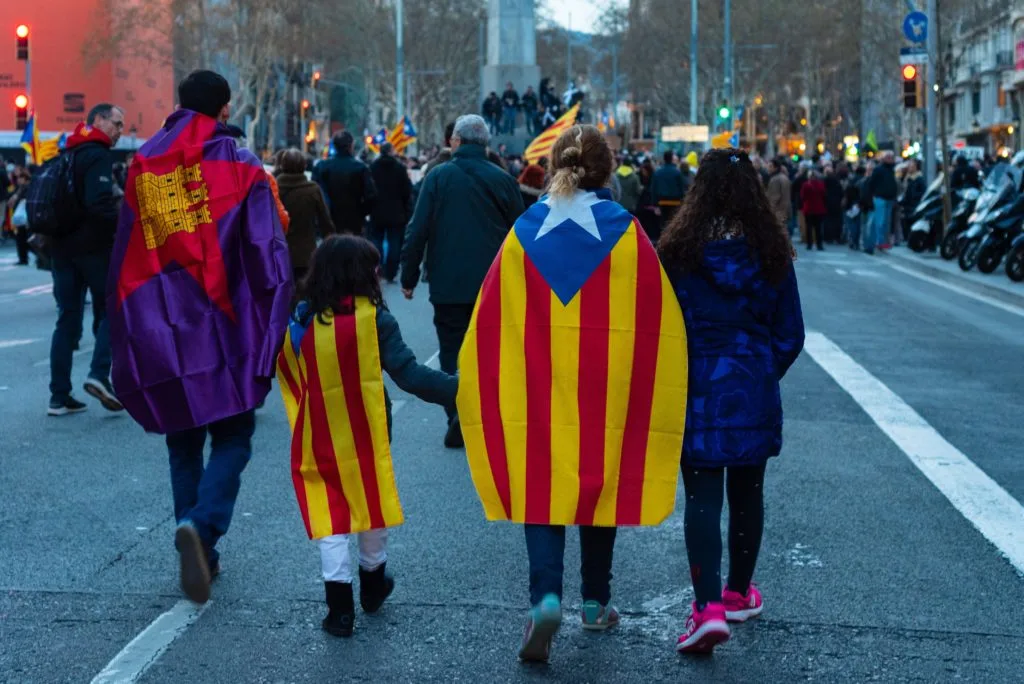
Catalan independence movement can be traced back until almost two centuries. Ever since the 1850s, there have been arguments for either further devolution (autonomy) from Spain, or full independence. Catalonia is internationally accepted as a part of Spain which is an autonomous community and has its own (regional) government and legislature functioning under the Spanish constitution. Throughout history, there have been attempts for independence, with the most recent one being an independence referendum held in 2017. This referendum was declared unconstitutional and invalid by the Constitutional Court of Spain. A subsequent declaration of independence was also declared invalid and no other state has recognised the independence of Catalonia.[1]
The legal situation of the Catalan independence movement is an issue of both human rights law and international law. Catalan claims of self-determination and the legal grounds of such claims will be considered with regard to the international documents and court decisions, emphasising on whether a right of external self-determination was formed. The legality of the process is also a matter regarded by the Spanish constitutional law and the courts of Catalonia, where the Spanish central government and courts claim that the actions of the independence movement result as a constitutional breach.[1]
What is the right of self-determination?
The global decolonisation process after World War II was being chaperoned by the newly reformed United Nations. The self-determination right of the peoples was recognised in the first article of the United Nations Charter in 1945.[2] This was followed in 1966 when Article 1 of both the International Covenant on Civil and Political Rights and the International Covenant on Economic, Social and Cultural Rights referred to the right of self-determination.[3][4]
The right of self-determination of peoples establishes freedom for “peoples” to decide on their own sovereignty and political future. The self-determination right of peoples is directly related to the secession of new states. Previous decolonisation process was perceived as a part of the self-determination right being exercised by a people to declare independence and sovereignty. Contemporary independence movements such as Catalonia, Quebec, Scotland or Kosovo also frequently refer to self-determination right and rely a potential (or achieved) success on the democratic preference (possibly through a referendum) of a formation of an independent secessionist country by their people. The legality of such claims are often disputed as matters of international law, where the right to self-determination (both externally and internally) is a complex issue where it does not develop in a binary way.
The legal literature divides the right of self-determination into two main components: internal and external self-determination. In order to achieve independence from another state, the easier method is to negotiate such decision and avoid a unilateral declaration. Albeit extreme differences in facts surrounding both cases, 2011 South Sudanese and 2014 Scottish independence referenda are examples for the aforementioned approach, where the results of referenda were to be respected by all parties. However, for Kosovo, the process of negotiations was not fruitful and Kosovo declared its unilateral independence from Serbia. Such declarations of independences are legally possible only through achieving external self-determination.
So how can a “people” achieve external self-determination? The answer is not fully definitive through charters, however, with the help of the ruling of the Canadian Constitutional Court in Reference re Secession of Quebec 1998 we can give three ways of the formation of the external self-determination right:
- People under colonial power can exert external self-determination right to break away from the colonial power.
- People who are subject to alien subjugation, domination and exploitation outside a colonial context can exert external self-determination right to move away from such treatment.
- People who are blocked from the meaningful exercise of its right to internal self-determination can exert external self-determination right to pursue secession.[5]
We can also add people who were the population of a State party to the United Nation Charter, or any of the two covenants of 1966 (the International Covenant on Civil and Political Rights and the International Covenant on Economic, Social and Cultural Rights) as a potential bearer of external self-determination right. This is a common approach arriving from the rights acquired at the time of signature and adoption.
Does the Catalan population satisfy the mentioned requirements of an external self-determination right?
To begin with, we have to clarify whether the population of Catalonia can be regarded as a “people”. Even though there is no definitive explanation to identify a group as “people” in this context, we can easily identify the Catalan population as a “people”. This is mainly because they are a population with distinctive features such as language and culture sufficient enough to be distinguished as a separate “people”.
When we introduce the principles mentioned above for the formation of an external self-determination right, we should observe where the Catalan people can base their claim of external self-determination. First of all, it is clear that the relationship between Spain and Catalonia is not a colonial relationship, so the Catalans are not colonial people. Also, there is not an argument for the presence of an alien subjugation, domination or exploitation. Adding that Catalonia was not directly a party to the United Nations Charter or the covenants of 1966, there is only one issue left to consider: deprival from the internal self-determination rights.
Depriving a people of their internal self-determination rights is usually explained through prevention from participating in the government. For example, following the start of intercommunal violence in 1963, Turkish Cypriots claimed that they were unable to access governmental facilities and thus could not participate in the government, where their seats were vacated from the national legislature. However, with Catalan members are still being members of the national legislature and other governmental offices, it is hard to entertain the claim of prevention from the government. Furthermore, there has not been interference by the central government to the internal bodies of the Catalan government prior to the declaration of independence.
However, it can be argued that the refusal of holding a referendum on the status of a people is an interference to the internal right of self-determination. Spanish central government and judiciary have repeatedly denied a possibility of a referendum, mostly citing that it would be unconstitutional since it is breaching the Spanish constitutional rule about the territorial integrity of Spain. This is a barrier against any form of negotiations between Spain and Catalonia towards agreeing into a legal referendum.[6]
It should be noted that the declaration of independence by Kosovo was also a breach to the Serbian constitution as it was an act against the territorial integrity of Serbia. Serbia declared that the unilateral declaration of independence by Kosovo was invalid and this is an integral problem regarding their territorial integrity.[7] A number of states, including the United Kingdom and the United States have immediately recognised the independence of Kosovo, on the grounds of remedial secession.[8][9] The International Court of Justice ruled in their Advisory Opinion, Accordance with International Law of the Unilateral Declaration of Independence in Respect of Kosovo 2010, that even though a declaration of independence can be legal or illegal within national jurisdiction, the international law itself does not prohibit or authorize such a declaration.[10] Therefore, it is perceived as a political declaration until another state recognizes such a declaration and thus, the state. The International Court of Justice ruled, as well as countries recognising Kosovar independence having parallel statements, that Kosovo did not form an example nor expanded the right to external self-determination. The claim is that Kosovo is a sui generis case and should not create a precedent for further secessionist acts. For the case of Kosovo, the secession was seen as a remedy to the inability of self-governance and it was only specific to the special status of Kosovo since the dissolution of Yugoslavia.
The sui generis principle does in fact prevent a precedent for Catalonia. However, the autonomous nature of Catalonia is also a point against the formation of remedial secession arising through an inability of self-governance. Catalan people have been accessing the central government while taking part in national elections freely. The autonomous status of Catalonia with a devolved parliament is also an important aspect in proving the ability of self-governance.
How can the Catalan people declare independence?
Similar to the Scottish referendum in 2014, Catalan people can reach an agreement with the national government to hold a “legal” (validated by the Spanish law) referendum. However, this would need an amendment to the Spanish constitution as it is illegal under current legislation. Such an amendment would need either a three-fifths majority from both lower and upper houses of parliament, or a simple majority from the upper house and a two-thirds majority from the lower house, or a simple majority in a referendum being held in the whole country. All three scenarios look unrealistic and need a great deal of negotiations to satisfy a large number of parties. It should also be noted that it is not certain that the majority of the population of Catalonia would vote in favour of independence if a legal referendum is to be held.
Political reality and the limitations to the international law
There have been other declarations of independence which are also disputed and not recognised by the majority of the UN member states. Abkhazia is one of such examples. Declaration of independence by Abkhazia is usually perceived contrary to the international law by many countries such as the United States, who refers to the territorial integrity of its ally Georgia.[11] However, countries such as Russia, Nicaragua and Nauru have recognised Abkhazian independence.[12][13] Therefore, it should be noted that when a unilateral declaration of independence is made, other states are able to individually recognise such declarations even if it is not valid under international law. The international law is limited when it comes to providing a remedy on how such breaches be prevented. Decisions of recognition are usually made with political goals. This is the case for most of the partially recognised states.
Conclusion
The situation regarding the right of self-determination of the Catalan people was discussed with considerations to the international conventions and cases along with other examples of secessionist declarations. It is observed that the current interpretation of international law does restrict the right of external self-determination to be applied for this case. This is mostly on the grounds that the Catalan people have been enjoying a healthy and democratic access to the central government as well as a good level of devolution needed for self-governance. These facts show that the Catalan people have not been deprived of their internal self-determination rights and they can pursue their economic, social and cultural development. The inability of deciding on own political status may not be seen as a meaningful breach to the internal self-determination rights in this context. However, if Spain refuses negotiations on further devolution, or a constitutional amendment, or any other way to ensure a referendum, further considerations can be made. The international law is an evolving area where changes of the political spectrum may result in different treatment of this situation. In the meantime, the United Nations and its member states are expected to respect the territorial integrity of a fellow member state as it is agreed by the General Assembly in Resolution 1541(XV) of 1960, and in Resolution 2625(XXV) of 1970.
References
[1] Jones, S. Catalonia's suspended declaration of independence: what happens next? The Guardian https://www.theguardian.com/world/2017/oct/11/catalonias-suspended-declaration-of-independence-what-happens-next (2017).
[2] United Nations. Charter of the United Nations. (1945).
[3] United Nations. International Covenant on Civil and Political Rights. (1966).
[4] United Nations. International Covenant on Economic, Social and Cultural Rights. (1966).
[5] Supreme Court of Canada. Reference Re Secession of Quebec [1998]. 2 SCR 217.
[6] Calamur, K. The Spanish Court Decision That Sparked the Modern Catalan Independence Movement. The Atlantic https://www.theatlantic.com/international/archive/2017/10/catalonia-referendum/541611 (2017).
[7] Reuters Staff. Serbia charges Kosovo leaders with treason. Reuters https://www.reuters.com/article/idUSHAM84253620080218 (2008).
[8] Reuters Staff. UK recognises Kosovo independence. Reuters https://www.reuters.com/article/uk-kosovo-serbia-britain-idUKL1824693920080218 (2008).
[9] Hamilton, D. U.S. and EU powers recognize Kosovo as some opposed. Reuters https://www.reuters.com/article/us-kosovo-serbia-idUSHAM53437920080218 (2008).
[10] International Court of Justice. Accordance with International Law of the Unilateral Declaration of Independence in Respect of Kosovo [2010].
[11] Office of the Press Secretary. President Bush Condemns Actions Taken by Russian President in Regards to Georgia [2008].
[12] Reuters Staff. Nicaragua recognizes South Ossetia. Abkhazia Reuters https://www.reuters.com/article/us-georgia-ossetia-nicaragua-idUKN0330438620080903 (2008).
[13] Reuters Staff. Pacific island recognizes Georgian rebel region. Reuters https://www.reuters.com/article/us-russia-georgia-nauru-idUSTRE5BE29J20091215 (2009).
Photo: Külli Kittus, Unsplash.