

Folk Dance and Music in Greek- and Turkish-Cypriot Communities: Period of Intercommunal Violence (II)
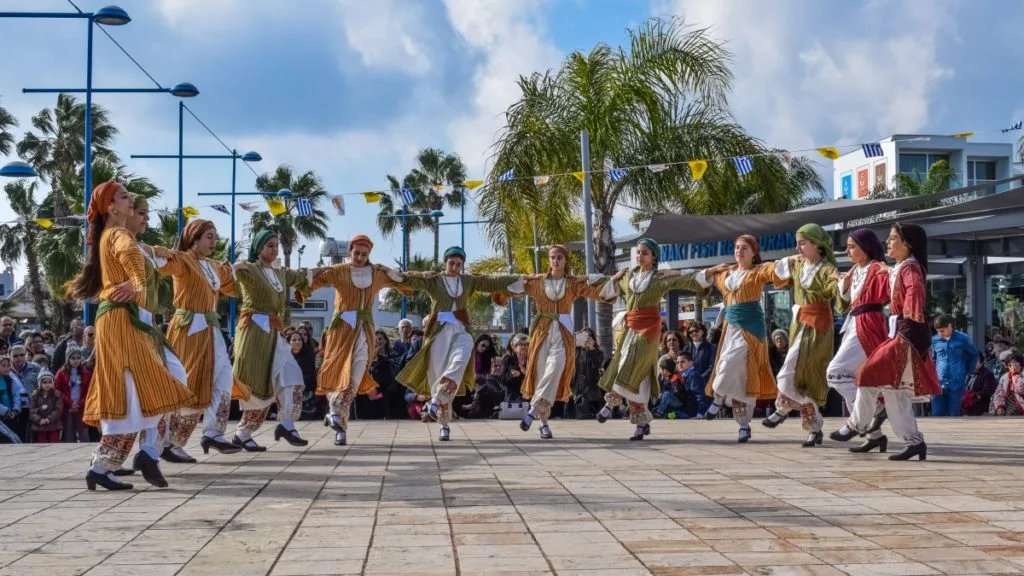
Continuing from the first chapter, the second chapter of "Folk Dance and Music in Greek- and Turkish-Cypriot Communities" will discuss the period between 1960 and 1974 to understand the effect of political and sociocultural factors on the journey of Cypriot folk tradition during the intercommunal violence period.
1960-1974: Attempts to Split the Cypriot Tradition
From the nineteenth century, the Orthodox church and a majority of Greek-Cypriots wanted a political union with Greece, calling the movement, enosis, while leaders from Turkey wanted to occupy Cyprus because they saw Cyprus as the expansion of Anatolia.[1] This national violence in the stemmed from some separation and conflicts between Turkish- and Greek-Cypriots in the 1950s. Foundation of the Republic of Cyprus in 1960 meant that both communities declared independence, and was assured by Greece, Turkey and Britain.[1] The agreements ensured to produce bi-communal legal support for Cyprus both politically and culturally. However, greater conflicts occurred in 1963-64; the inter-communal violence between Greek- and Turkish-Cypriots was intense, which transferred more than 25,000 Turkish-Cypriots to enclaved areas.[2] Through these political and cultural changes, Romantic nationalism (i.e., form of nationalism (in language, culture and history), where the state stems its political authority and consciousness as an organic result of the unity of the governed people) arose in Cyprus and affected the music and dance folk culture.
Regarding political changes in the early 1960s, the study of folklore became more significant to obtain cultural policies in Cyprus.[3] Due to the presence of the folklore, the most important aim of the policies was to make sure that the nations’ (i.e. the motherlands’) essence is long-lived and protected. Cypriot folklorists essentially researched the folk dance of Turkey and Greece separately to find links between them during the early twentieth century. By doing the research, unprofessional researchers decided to bring teachers from Turkey and Greece to teach Turkish- and Greek-Cypriots their motherlands’ folk dances and music, respectively[4]; one of many attempts in Turkifying or Hellenising the folk tradition of Cyprus during the 1960s.[1]
Even in 1959, a teacher from Turkey was invited to teach Turkey’s traditional dance to Turkish-Cypriots, and also study the Cypriot dances to detect any differences. However, the teacher commented that it was very challenging to separate motifs, movements, and melodies between the two communities, and would demand long-term research to find the differences.[1] Instead, motherland teachers taught Cypriots how to be proper Turks and Greeks by teaching motherlands’ dances and music.[1] Thus, the Cypriot music and dance folk tradition began to transform into Turkish and Greek folk music in the Cypriot community, which had an impact on the fading of the tradition.
Through Turkifying and Hellenising in the 1960s, folk music and dances of Turkey and Greece were operated to transfer yesterday’s siblings into today’s strangers. In the case of Turkish-Cypriots, Turkish folk groups were formed with an accent on Turkish repertory instead of the Turkish-Cypriot repertory. This was indicated by the control given to the saz (bağlama) in folk music and dances. Saz (bağlama) is an instrument, which belonged to Anatolia but did not historically belong to Cyprus before 1960.[5] It was also very apparent that Turkish-Cypriots were similar to Turks as they shared a language and many Anatolians were transported to Cyprus during the Ottoman rule. Indeed, the Turkish-Cypriot community was originally more comfortable after Cyprus’s Independence in 1960 as the risk of enosis had been withdrawn.[6] However, shadowing the events of 1963, which was the initiating time of the inter-communal conflict as most of the mixed villages were vacated and people moved to protected locations. In these locations, Turkish-Cypriots were forced only to speak Turkish by the Türk Mukavemet Teşkilatı (TMT) (Turkish Resistance Organization)*. Many Turkish-Cypriots also knew how to speak Greek, and some, especially those who lived in mixed villages, mainly spoke Greek; therefore, life became trickier for them. Thus, Turkifying was especially evident through the use of instruments and language in the Turkish-Cypriot community following the events of 1963-64, by also causing the common Cypriot folk culture to tail off.
In terms of the education system of Turkish-Cypriots, it was the same as the system in Turkey.[6] Textbooks were introduced from Turkey, and some high-school teachers also came to the island, particularly to teach "proper" Turkish language and literature.[6] Students were made to believe that Turkish-Cypriot dialect was contaminated and unpleasant.[6] Thus, Turkish-Cypriots were quickly getting used to the Turkish education system and changing dialect by adapting the culture, which not only affected the change of the Cypriot folk dance to Turkish, but also the spoken lyrics of the Turkish folk music in a Turkish dialect.
For Greek-Cypriots, it was a case of standardising the Cypriot dances after the establishment of the Republic of Cyprus in 1960. More modern, masculine and Hellenic Cypriot dance repertoire was presented by the Greek-Cypriots through choreographing the Cypriot dances performed only by Cypriots before the 1960s, as they found Turkish-Cypriots more feminine due to their Islamic religion[7] and Islamophobia amongst the Greek nationalists. As Said stated:[8]
“For Europe, Islam was a lasting trauma. Until the end of the seventeenth century the 'Ottoman peril' lurked alongside Europe to represent for the whole of Christian civilization a constant danger, and in time European civilization incorporated that peril and its lore, its great events, figures, virtues, and vices, as something woven into the fabric of life.”
Moreover, Greek-Cypriot’s urged to understand homophobia, and cultural and sexual identity as in the way of comprehending their national identity, which still continued in the 1960s. Effects of the modern masculine sexual crisis were also seen in folklore entertainment. Papakadis’ views[1] are based on the religion of both communities, such as by relating the sexuality of "Turks" to identify the religion and culture of Turkish-Cypriots. He states:
“Homosexuality was often said to be another corrupting influence from the Turks who ruled Greece for 400 years. The act itself was... meaning the Ottoman way. Didn’t the Ottoman rulers like to keep a plump, young boy at their side for entertainment of various sorts... The word for homosexual in Greek was poushtis. This was a Turkish word, not a Greek one, and etymology, as we all knew, provided conclusive proof with regards to origins.”
By influencing the Greek-Cypriots with the words of religion and sexuality, their effect on the folklore practice was tremendous on the side of Greek-Cypriots. This curiosity about learning the motherland’s folk dances lasted until the end of the twentieth century. Indeed, each side’s nationalist ideas were developing immensely through Hellenising and Turkifying and destructing the Cypriot folk tradition.
Moreover, as Karayanni describes:
“In the Turkish-Cypriot community there existed some elements deemed undesirable by a Greek Cyprus that aspired to Western identity. Turkish Cypriots used percussion instruments with undesirable North African and oriental associations, and a wind instrument called zorna... The zorna in its different forms and variations has been very popular in Egypt, Turkey, on some of the Greek islands, and especially in northern Greece. But when the zorna is played in the northern Greece, it is an instrument that connects the cultural present with the glorious ancient Greek past, whereas when Turkish-Cypriot or Egyptian musicians play it, then it is coarse 'gypsy' music without sophistication.”[7]
Thus, although Greek- and Turkish-Cypriots still shared the same music, musical instruments and dances, their ethnic interpretation from others (such as Turkey and Greece) and also from them affected the cultural Cypriot folk tradition. It is also seen that both communities influenced each other when choosing an instrument for their folk music and dances, as they shared zorna.[7] As Turkish- and Greek-Cypriots were reported to live unseparated and often in mixed villages until the start of conflicts, both communities were influenced by each other as well as from their motherlands. Therefore, although there were many attempts, especially externally, to diminish the Cypriot tradition, the use of folk music and dance instruments did not change, meaning the Cypriot folk music did not change. The next chapter of this work will cover the period between 1974-2003.
Note
*Türk Mukavemet Teşkilatı (TMT) was an organisation largely formed as a comeback to the Greek-Cypriot EOKA movement in 1958, which increased Turkification in the island. EOKA is the acronym of Ethniki Organosis Kyprion Agoniston (National Organisation of Cypriot Fighters), which was the nationalist organisation established to end the British rule in Cyprus for the enosis. For further information, see Mallinson (2005).[9]
References
[1] Papadakis, Y. & Hatay, M., The Cultures of Partition and the Partition of Cultures. in Music in Cyprus (eds. Samson, J. & Demetriou, N.) 19-36. (Surrey: Ashgate Publishing Limited, 2015).
[2] Hoffmeister, F. Legal Aspects of the Cyprus Problem: Annan Plan and EU Accession. (Martinus Nijhoff Publishers, 2006).
[3] Samson, J. & Demetriou, N., Music in Cyprus. (Surrey: Ashgate Publishing Limited, 2015).
[4] Tsangardiou, E., One Music, Two Labels. in Music in Cyprus (eds. Samson, J., & Demetriou, N.) 37-56. (Surrey: Ashgate Publishing Limited, 2015).
[5] Kızılyürek, N., Gautier-Kızılyürek, S., (2004). The politics of identity in the Turkish Cypriot community and the language question. International Journal of the Sociology of Language, (168), 37-54.
[6] Azgın, B., Transforming Culture: Traditional Music and the Turkish Cypriots. in Music in Cyprus (eds. Samson, J. & Demetriou, N.) 77-88 (Surrey: Ashgate Publishing Limited, 2015).
[7] Karayanni, S. S., Moving identity: dance in the negotiation of sexuality and ethnicity in Cyprus. Postcolonial Studies, 9, 251-266 (2006).
[8] Said, E. Orientalism. (New York: Vintage, 1979).
[9] Mallinson, W. Cyprus: A Modern History. (London: I. B. Tauris, 2005).
Photo: PxHere, CC0 Public Domain.