

Child Marriage Among Girls in the World: How Much is the Cost?

In the region of the Middle East and North Africa, approximately one in five girls are married before the age of 18 according to UNICEF (United Nations Children’s Fund).[1] This problem affects not only the education and psychology of the girls who are forced into a marriage but also their professional life in the future; many child brides end up working for low-income jobs or not joining the labour force. This is mostly due to a lack of education and opportunities. The studies from the World Bank and many other organisations show that tackling child marriage would save the individual, their families and the economy from the various social and financial costs, and possibly help them have better lives.[2] There are a lot of organisations working to end child marriages in the near future but the efforts need to be increased significantly. The problem is mostly in the parts of the world which are poorer and tackling this can benefit the whole economy significantly.
Child marriage is mainly the effect of poverty. Children are seen as expenses to the family and thus are married away so that they are financially supported by another family. This is a big mistake that limits the futures and the potentials of the children that are forced to marry, as it usually takes away the basic human right of education from the children as well as their health in most cases due to enforced maternity at a young age. In many cultures, women are mainly seen as carers and sole child-bearers. In some religions, women are portrayed as the second-class sex which affects the views of the followers of these traditions and religions. Due to the education gap between men and women, the ideas of people surrounding women has not changed through the years as it has in a lot of the developed countries. These factors are also huge obstacles in the road to ending child marriages.
There has been a lot of ongoing work to combat child marriage in the world by various organizations like UNICEF. According to UNICEF “Overall, the proportion of women who were married as children decreased by 15 per cent in the last decade, from 1 in 4 to approximately 1 in 5.”[3] In the article, Anju Malhotra, the Principal Gender Advisor of UNICEF points out that each girl who is prevented from marrying carries a chance to fulfil her potential and is relieved from the risks of marrying at a young age including sufferings during pregnancy as well as societal consequences. This brings to mind questions like what opportunities, what wonders are missed because of child marriages. The children who are married could have been scientists, educators, philosophers, world changers but instead, they are children themselves mothering children.
According to the research done by the World Bank together with ICRW (International Center for Research on Women), women who were child brides earn a significant rate of 9% less than women who marry over the age of 18. This shows how much child marriage is forcing girls to be stuck in the circle of poverty due to the fact that they earn less compared to other women who have a certain degree of education and are earning more to contribute much more to the economy of their families. Compared to women with higher income, they are more likely to force their own children for early marriages, as well. Even though marriage affects the labour force participation insignificantly, the lack of education directly affects the income of the individual according to the research conducted by the World Bank and the ICRW.[2] In the same research, it suggests that globally, the welfare benefits of ending child marriage from 2014 to 2030 would be more than $4 trillion and if early childbirth is also considered, more than $5 trillion in PPP (Purchasing Power Parity) terms. As child marriage is mostly the problem of the poorer parts of society in developing countries, it is safe to assume that these economies could benefit immensely from ending child marriages. The UN (United Nations) through the Sustainable Development Goals under Gender Equality, aims to end child marriages until the year 2030 but this does not seem to be happening with the current rate of decrease. These could be seen in Table 1.
Table 1
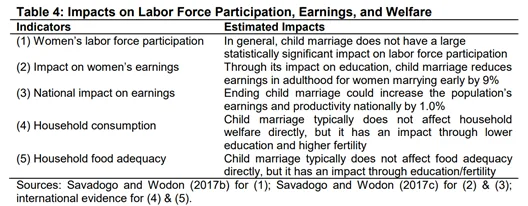
Wodon, Q., et al (2017). Economic Impacts of Child Marriage: Global Synthesis Report, Washington, D.C.: The World Bank and International Center for Research on Women.
The work of the UN is very significant; it is estimated that approximately 25 million girls are prevented from marrying at a very young age in the last decade because of the actions taken by them. Although this is the case, according to UNICEF, if the efforts are not increased, there will be 150 million more girls who would be forced to marry very early until the year 2030. It also states that to tackle child marriages and end it by 2030, the efforts need to be "significantly accelerated." [3] This requires action not only from huge organisations like the UN but also individual and governmental action which would not only be towards changing the laws but also social views of the people.
In 2018, during the 73rd General Assembly of the United Nations (UNGA73), the UN has adopted its third resolution on child, early and forced marriages. 126 state members have co-sponsored the resolution – a very significant increase from the previous resolution of 2016 – which addresses a lot of issues regarding the inequality of the sexes. One of the most significant details is the urging of countries to implement and conduct the resolution, as well as to monitor child marriages and not to allow their members to marry before the age of 18. Another very important point is the fact that some states have laws that allow rapists to go unpunished if they are married to the victim. This is crucial as it is unimaginable for a human to have to live with his/her attacker after all the psychological and physical damage he/she has lived through. The main aim of the resolution is to increase the number of research and data collection before the next UN General Assembly and to understand how much effect the actions taken in the previous years have on preventing child, early and forced marriages. This would provide us with a much better understanding of the current situation and show the member states to what extent they need to improve their efforts towards reaching the elimination of child marriages by 2030.
The actions by the United Nations and the implementation of the Sustainable Development Goals have improved the situation dramatically. They have been in contact with governments as well as organisations to improve the situation of young girls, and to tackle the issue of early marriages. Laws implemented to ban child marriages by individual states such as Zimbabwe, Gambia and Tanzania which has implemented laws to ban child marriage in 2016 has helped reduce the number of child marriages dramatically as well.[4] Specifically in the Middle East and North Africa, while the percentage of child brides was around 33% in 1990, it was 19% in 2015. If we can accelerate our efforts, we can reach a dream number of 4% until the year 2050 (For detailed information, see Figure 1). This could be an amazing achievement, but the world should only stop combating this problem when the rate is 0%.
Figure 1
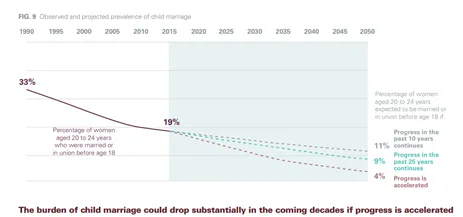
A Profile of Child Marriage in the Middle East and North Africa, UNICEF Middle East and North Africa, July 2018
The main reason for child marriage is poverty but conflict is a strong factor too. It is also true that in cases of conflict and consequent uncertainty, people feel very insecure about their futures. Palestine is a good example of the factor of conflict, the insecurity and the uncertainty; especially when people are being attacked by the occupier Israel. On top of everything, nationalism in Palestine increases the number of child marriages since the people want to "utilise" their daughters by marrying them in pursuit of having new Palestinian blood who will take part in the continuation of the Palestinian cause and fight. This then decreases children’s chance of receiving education, thus the children who are married also become forced to follow the path of their parents and live a life trapped in this circle of poverty.[5] The Palestinian National Authority has taken action against this practice by setting a new law in 2019 that would not allow children under 18 to be legally married. This is a very positive step as the previous law was that girls could be married when they are 15 and boys when 16.[6] Through this new law, Palestine can increase their level of education and in the long run, gain from the productive and innovative power of the girls who were not married when they were children. These women later can join the labour force as well as create their own businesses and increase the income of their families which would decrease the demand for child marriages further. As an oppressed state struggling under harsh conditions against the occupier Israel, this is a great achievement that can benefit them in the long run; with a less dependent economy and higher GDP.
In Palestine, one problem standing between ending child marriage and status quo is also the fact that there is strong gender inequality. Some Palestinian women are oppressed and cannot even participate in the labour force in any stage of their lives even if they were not child brides.[7] This shows that even if the problem of child marriages is tackled through different laws and regulations, there is also a social stigma to overcome. The people of Palestine should be introduced to the fact that women can achieve much more than having kids and being great mothers and carers but can also achieve great things in their professional and innovative lives. This can add significantly to the current economic situation of Palestine and could even ease the level of oppression enforced by the Israeli government.
Another good example is Turkey. In 1997, the Turkish government implemented a law stating that compulsory education of children would be increased from 5 years to 8 years (from the end of primary school to the end of secondary school). This has had a huge impact in the country where the average age of first marriage, as well as the average age of first birth, has risen. The rate of child marriage experienced a significant decrease from 44% to 36%.[8] This proves that improving and increasing the amount as well as the quality of education would tackle the issue of child marriages directly.
Tackling the issue of child marriage is not very easy; the issue has been a part of traditions for a lot of communities as well as the legal system in a lot of countries even to date. Traditions are hard to get rid of, and since a lot of people do not understand the impact of child marriage in their social and economic life, it is a hard task. One of the most effective ways to improve the current situation is to change the education system to be more informative, free-of-charge and compulsory until the age of 18. This way children not only stay in school and get their necessary education to fulfil their potential to an extent but also avoid getting married since the girls are more in charge of their own life. This can also be supported by extra governmental bursaries and credits given to students coming from a financially struggling background. Another very important action that could be taken is to reach financially struggling people through raising awareness. The average person gets influenced by numerous people and settings. Thus, if people inform each other of the benefits of ending child marriage, promoting and supporting the elimination of child marriage, the informed person is more likely to understand and work towards solving the problem, allowing their children to be "utilised" as a productive power in the economy instead.
References
[1] A Profile of Child Marriage in the Middle East and North Africa, UNICEF Middle East and North Africa. https://www.unicef.org/mena/reports/profile-child-marriage#:~:text=Child%20marriage%20is%20now%20firmly,were%20first%20married%20in%20childhood (2018).
[2] Wodon, Q., et al. Economic Impacts of Child Marriage: Global Synthesis Report. http://documents1.worldbank.org/curated/en/530891498511398503/pdf/116829-WP-P151842-PUBLIC-EICM-Global-Conference-Edition-June-27.pdf (World Bank and International Center for Research on Women, 2017).
[3] 25 million child marriages prevented in the last decade due to accelerated progress, according to new UNICEF estimates. UNICEF. https://www.unicef.org/press-releases/25-million-child-marriages-prevented-last-decade-due-accelerated-progress-according#:~:text=NEW%20YORK%2C%206%20March%202018,to%20approximately%201%20in%205 (2018).
[4] 5 SIGNS WE MADE PROGRESS TOWARDS ENDING CHILD MARRIAGE IN 2016. Girls, not Brides. https://www.girlsnotbrides.org/5-signs-made-progress-towards-ending-child-marriage-2016/(2016).
[5] Pettit, J. et al.. Adolescent girls in Gaza: The state of the evidence. Gage. https://www.gage.odi.org/wp-content/uploads/2019/01/Adolescent-girls-in-Gaza-The-state-of-the-evidence.pdf (2017).
[6] Abumaria, D. Palestinian authority outlaws child marriage. The Jerusalem Post. https://www.jpost.com/Middle-East/Palestinian-Authority-outlaws-child-marriage-607963 (2019).
[7] Social and Economic Situation of Palestinian Women and Girls. Economic and Social Commission for Western Asia. https://reliefweb.int/sites/reliefweb.int/files/resources/social-economic-situation-palestinian-women-2016-2018-english.pdf (2016).
[8] Addressing child marriage through education: What the evidence shows. Girls, not Brides. https://www.girlsnotbrides.org/wp-content/uploads/2018/01/Addressing-child-marriage-through-education-what-the-evidence-shows-knowledge-summary.pdf (2018).
Photo: Cristian Newman, StockSnap