

Transmissible Cancer Disease of Tasmanian Devils
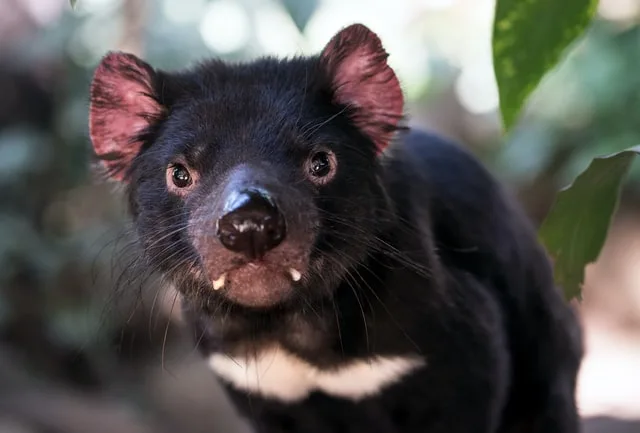
There is no debate on the fame of the “Tasmanian Devil” cartoon. With the smiles on your faces, I can confirm that he was one of our childhood heroes. However, this essay will not be based on “Taz”. Have you ever heard about the real Tasmanian devils? The real Tasmanian devils behave almost like Taz: they swirl around with temper, protect their food, defeat others for mating, etc. However, there is a big difference between the real ones and Taz, and the difference is that the aggressive behaviour of real ones is an example of feeding practices or being frightful.[1] This essay will briefly cover the real Tasmanian devils, their aberrant fortune for being endangered and the transmissible Tasmanian cancer causing all the carnage.
About Tasmanian Devils
Tasmanian devils (Sarcophilus harrisii) are the biggest surviving marsupials -animals which carry their offsprings in their pocket like body parts, another example is kangaroo- with a dog-like size, carrying a weight between 7-11 kilograms.[2][3] Mainland Australia used to have a Tasmanian devil population; however, the introduction of Asian dogs was blamed for causing the extinction of all devils on the mainland about 400 years ago.[1] They are indigenous to the famous Australian island, Tasmania, and they give birth to undeveloped babies as the last stages of development are completed in the pouch of the mother.[3] One other interesting fact is that devils have only four nipples; therefore, only the best-fit ones among 20-30 offspring can survive.[1]
Giant Decrease in Tasmanian Devil Population
The population of Tasmanian devils was as high as 140,000 in Tasmanian island; however, after an enormous decline, the population nowadays is around 20,000.[1] The downward trend in the population can be correlated with the introduction of invasive species: the red fox outcompete them for resources such as food and habitat and the farmers who believe devils are pests harass them.[4] Nevertheless, the biggest and the main reason behind the devastating decline in the population of this endangered species is a specific cancer type known as the devil facial tumour disease (DFTD) which threatens 60% of the population, and in some areas of Tasmania, the frequency is as high as 83%.[4] International Union for Conservation of Nature (IUCN) added these devils to its red list. IUCN also blamed the same reasons for this huge considerable decline and highlighted the horrendous decline in North East Tasmania, where up to 95% of the local population is lost.[5]
A Study to Predict Extinction
In 2009, the University of Tasmania, based on "host-pathogen theory", published its epidemiology-dependent study in the journal Ecology.[6][7] It made inquiries about the dependence of transmission of DFTD and the host population of Tasmanian devils to discover if there is a risk of extinction related to DFTD.[7] Meanwhile, it was known that the probability of DFT cancer to have one host (Sarcophilus harrisii) was very high. In simplest terms, you can think this situation as DFT being very likely to be the disease of the devils.[7] Additionally, host-pathogen theory [6] puts forward that when there is a single host for a single pathogen, the extinction of pathogen happens before its host species extinction. Therefore, it is assumed that the host density most of the time adjusts the transmission of pathogen.[7] In situations where the host density has nothing to do with pathogen transmission, the pathogen can manage to extirpate the host population.[8] I was amazed by this study which took all these parameters into account and provided first values for basic reproductive number, R0: the average number of expected cases in a homogenous population.
They have concluded that there is a frequency-dependent transmission in Tasmanian devils instead of a density-dependent one since the prevalence of the disease was over 50% for devils aged between 2-3, and a 90% decrease in population was present.[7] In simplest terms, only 10% of the population was left to be infected, and out of that ten percent, 50% of Tasmanian devils aged between 2-3 were protected from DFTD. Despite the low population density, the transmission increases. There is no threshold density for transmission, it remains even at low densities. Findings led to the presence of extinction risk and the research group insisted on the importance of future research based on the local extinctions and recommended programs to obtain a disease-free population.
Characteristics of Devil Facial Tumour Disease (DFTD)
Most frequently, DFTD tumours are seen on the face, neck, and the inner part of the mouth.[2] In 1996, DFT1 was seen for the first time in history and within 20 years, a second type of DFTD, DFT2, was detected.[6] Tasmanian devils have the tendency to bite each other’s faces during mating or defending their food, which is thought to be the main source of spreading the cancer cells between each other.
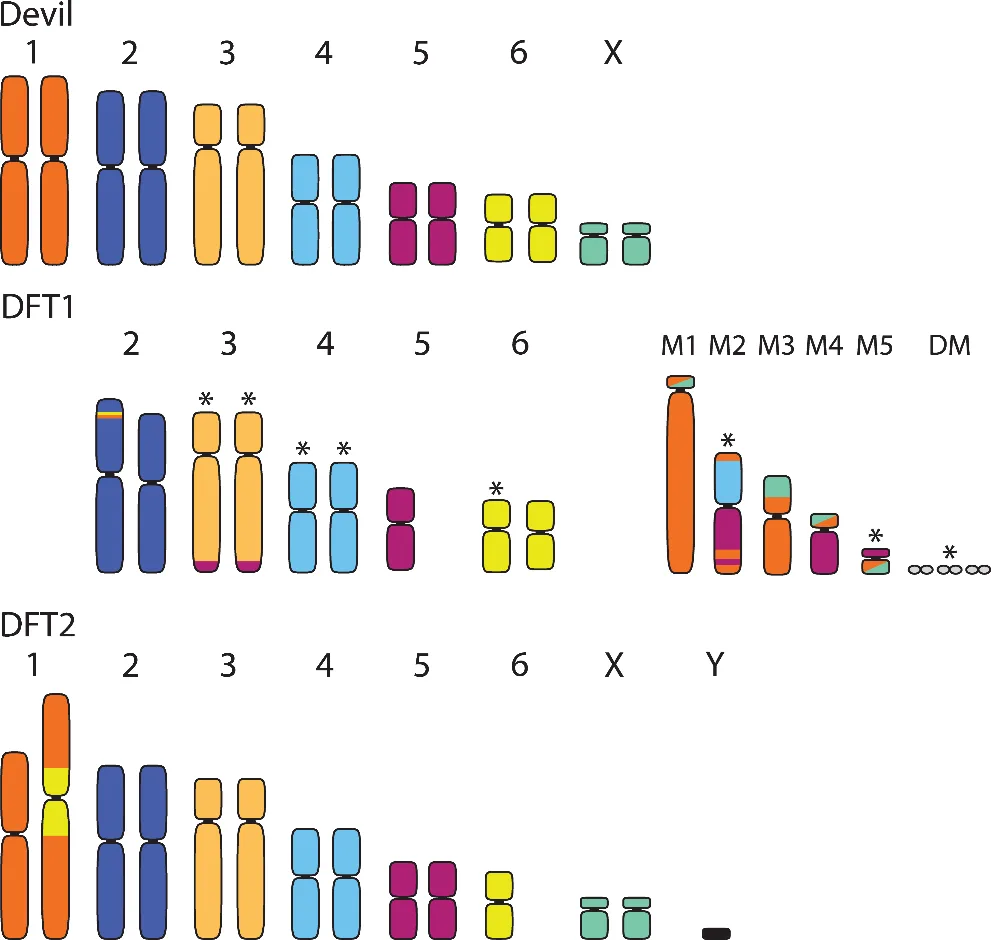
Remains of dead devils and eating the same prey are the minority reasons for the spread.[7] As long as the tumour is invisible, there is no record of transmission;[7] however, after external emergence of the tumour, it kills the victim within six months.[9] The origin of the mutations which lead to the transmission of tumours is still unknown; however, chromosomal rearrangements have been detected and blamed to be the cause of transmission. For clarification, in Figure 1, you can see that chromosome 1 is fused with chromosome 5. X and other chromosomes then form new arrangements shown as M1, M2, M3, M4 and M5 in DFT1. As also seen is, for DFT2, one arm of chromosome 6 is integrated into one arm of chromosome 1. It is also known that DFTD cells do not express antigens on their receptors. Therefore, immune cells in Tasmanian devils cannot recognise them. As a result, they manage to escape from the immune system and develop into tumours.[11]
All in All
This transmissible cancer is a big threat for Tasmanian devils. As a result of my research, I have realised that devils may have started to become resistant to DFTD; however, there is a lack of research on this topic to make a clear conclusion. Another point here is the lack of sufficient information on how the transmission of the disease occurs in molecular terms. We can raise awareness to increase funding to allow our prestigious and ambitious scientists working with Tasmanian devils to find more answers that will help to save them.
References
[1] Tasmanian devil. National Geographic. https://www.nationalgeographic.com/animals/mammals/t/tasmanian-devil/.
[2] Murchison, E. Clonally transmissible cancers in dogs and Tasmanian devils. Oncogene 27, S19–S30 (2008).
[3] "Tasmanian devil facial tumour disease (DFTD)". Transmissible Cancer Group. University of Cambridge. https://www.tcg.vet.cam.ac.uk/about/DFTD#:~:text=Tasmanian%20devil%20facial%20tumour%20disease%20(DFTD)%20is%20a%20transmissible%20cancer,cause%20death%20of%20affected%20animals.
[4] Tasmanian devil. http://animalia.bio/tasmanian-devil.
[5] Hawkins C.E., McCallum H., Mooney N., Jones M. & Holdsworth M. Sarcophilus harrisii. The IUCN Red List of Threatened Species 2008. e.T40540A10331066.
[6] Anderson R. M. Discussion: the Kermack-McKendrick epidemic threshold theorem. Bulletin of Mathematical Biology, 53: 3–32 (1991).
[7] McCallum H., Jones M., Hawkins C., Hamede, R., Lachish, S., Sinn, D. L., Beeton, N. & Lazenby, B. Transmission dynamics of Tasmanian devil facial tumor disease may lead to disease-induced extinction. Ecology 90, 3379-3392 (2009).
[8] de Castro F. & Bolker B. Mechanisms of disease-induced extinction. Ecology Letters 8, 117–126 (2005).
[9] Hawkins C. E., Baars C., Hesterman H., Hocking G. J., Jones M. E., Lazenby B., Mann D., Mooney N., Pemberton D., Pyecroft S., Restani M., Wiersma J. Emerging disease and population decline of an island endemic, the Tasmanian devil Sarcophilus harrisii. Biological Conservation 131, 307–324 (2006).
[10] Storfer A., Hohenlohe P. A., Margres M. J., Patton A., Fraik A. K., Lawrence M., Ricci L. E., Stahlke A. R., McCallum H. I. & Jones M. E. The devil is in the details: Genomics of transmissible cancers in Tasmanian devils. PLoS Pathogens, 14, e1007098 (2018).
[11] Siddle H. V. & Kaufman, J. How the devil facial tumor disease escapes host immune responses. Oncoimmunology 2, e25235 (2013).
Photo: David Clode, Unsplash.