

Michelangelo: The Creation of Adam
I started writing this article the day before my committee exam, after studying one of my favourite lectures: the history of medicine. As a medical student with no previous interest in art I can say that the history of medicine is such an interesting subject. In my mind the integration of science with art is compelling. It is full of imagination, talent, and a little bit of wildness with the urge of discovering. You learn how people explored their own body even one by one when dissection was forbidden and vivisection was not a type of punishment. There are many names I came across while learning the history of medicine and Michelangelo is the most outstanding one; reasons for which I will discuss in the piece.
Michelangelo was a brilliant Renaissance sculptor and a painter from Italy. Keep in mind that, just to respect the dead, Michelangelo would have hate it if you referred to him as a painter first. His pieces have a value in terms of art but the thing which made Michelangelo very unique was his ability to combine medicine with art in mysterious ways. He was one of the few sculptors who craved his sculptures in detail: I can go to a gallery and study every muscle and nerve on his sculptures. Moreover, if you look deep into his frescoes, you might be able recognise anatomical structures too. There are secrets he hid in his frescoes that could not be deciphered until the 1990s.[1] There is no doubt that he had a skillful pair of hands but he was also a genius with extensive knowledge of human anatomy that he acquired by performing and observing dissections.
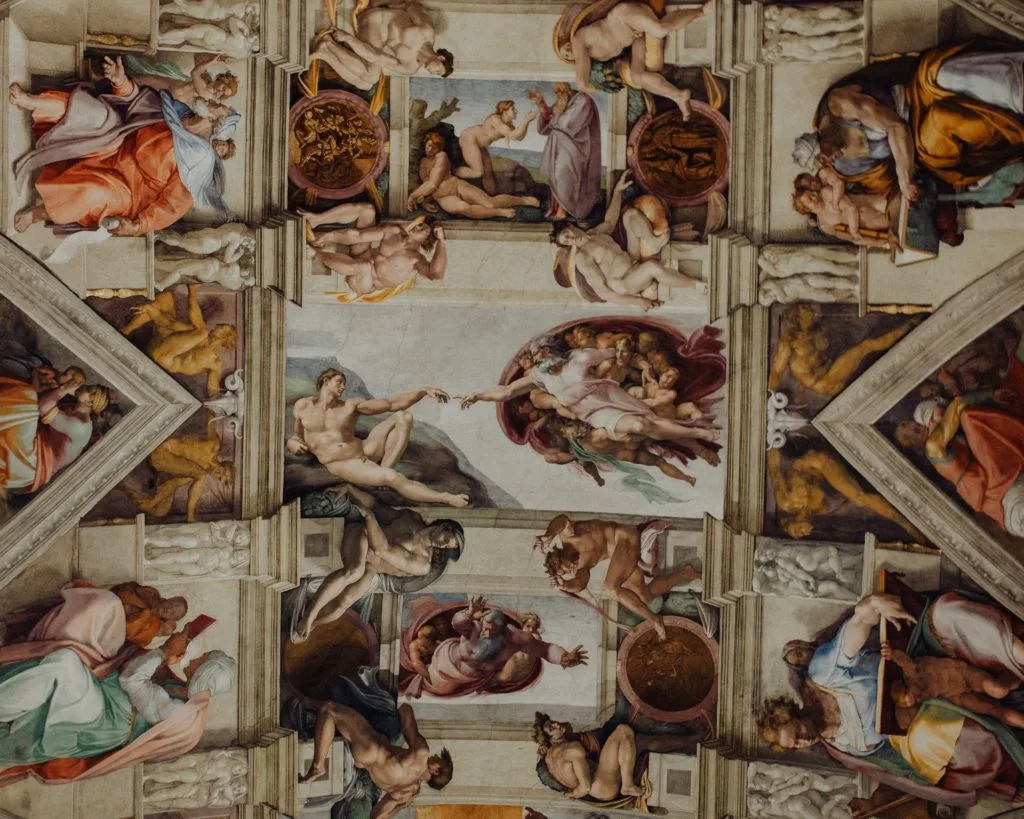
One of the most popular frescoes of his is The Creation of Adam, which is painted on the ceiling of the Sistine Chapel (Figure 1).[2] At the start of 1500, the frescoes found in the Sistine Chapel were conserved and restored by Pope Julius II. Back then, just before Michelangelo was invited to Rome for the frescoes in the Sistine Chapel, he was invited to build Pope’s tomb. Unfortunately, Michelangelo was disappointed by Pope Julius II as he was constantly interrupted by other tasks. At last, the two of them agreed that Michelangelo would only be responsible for painting the ceiling of the chapel and finishing the Pope’s tomb sculpture. This particular fresco includes figures of Adam and God, almost touching each other with their fingertips. In those times, it was believed that from the fingertip of God, "the spark of life" was transferred to the fingertip of Adam. God gave life to Adam, God created Adam; the human being. However, the most significant detail is not Adam being alive but the third character, recognised by Meshberger (1990) after nearly 400 years: the outline of the human brain (Figure 2).[1] A change of perception from the cloud to the brain altered the whole meaning of the fresco.
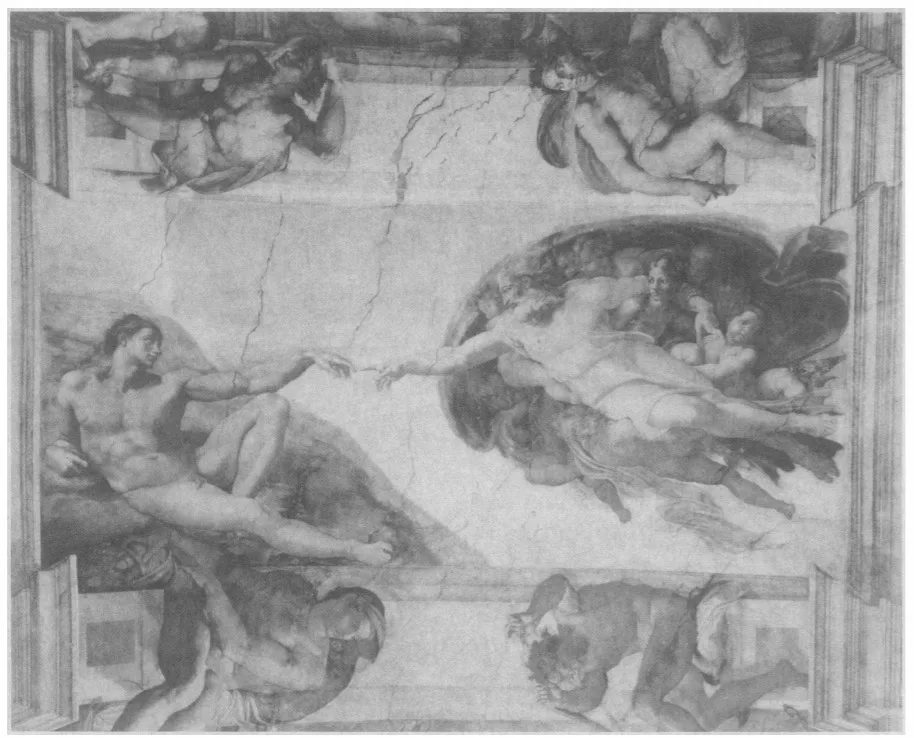
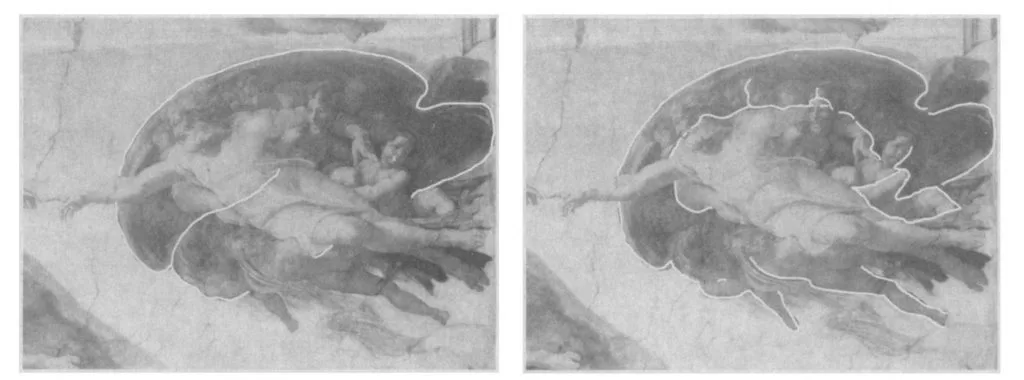
He might have tricked the human race for years until one of us, Frank Lynn Meshberger, recognised the brain in the fresco. He might have made us believe that his art symbolised Christianity when actually it symbolised atheism. Michelangelo was convinced that "the 'intellect'" was what God bestowed humans as "the 'divine part'" and he explained his drawing process in these words:[1]
After the divine part has well-conceived
Man's face and gesture, soon both mind and hand,
With a cheap model, first, at their command,
Give life to stone, but this is not achieved
By skill. In painting, too, this is perceived:
Only after the intellect has planned
The best and highest, can the ready hand
Take up the brush and try all things received.
I hold the view that Michelangelo was committed to his art more than he was committed to his God. Also, I guess a man who can accept the fact that Adam had the intellect to plan the highest and the best, can also predict that God is a creation of the mind. However, he might have just wanted to symbolise that the God is in our minds. God is not an object: he cannot be seen but he can be felt, and feelings are formed in the brain. No one can deny that God cannot be seen, he is always in the brain.
But why did it take us 400 years to solve the message?
Even in the 11th century, people were able to practice dissection and observe the human brain.[3] Park Maybe we could not guess that Michelangelo might have been an atheist or that he was able to code a secret message.
The simplest logical explanation is that we only see but do not look deep into things.
References
[1] Meshberger, F. L. An Interpretation of Michelangelo's Creation of Adam Based on Neuroanatomy. JAMA, 264, 1837-1841 (1990).
[2] Pietrangeli, Carlo et al. The Sistine Chapel : The Art, the History, and the Restoration. (Harmony Books, 1986).
[3] Park, Katherine. The Secrets of Women : Gender, Generation, and the Origins of Human Dissection. (Zone Books, 2006).
Photo: Calvin Craig, Unsplash.