

Folk Dance and Music in Greek- and Turkish-Cypriot Communities: An Introductory Overview (I)
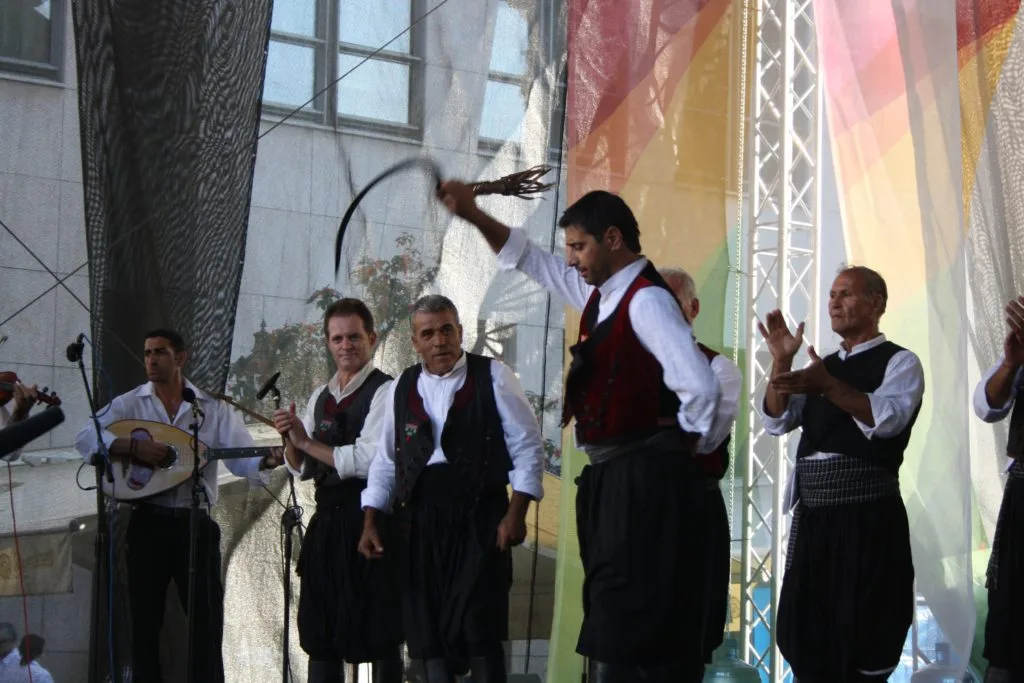
Folk dances are created to express society’s own historical identity as a whole;[1] by transferring the psychological moments of individuals into bodily action accompanied by music.[2] Yet, Cyprus’s folk culture also represents the political and sociocultural context within it; by following the folk dances and music tradition from the 1960s, its purpose has served a political goal: continuation of "Cypriotness" into future generations.[3] This is important when considering the fact that ethnic and cultural differences were utilised by the nationalists to separate Turkish- and Greek-Cypriots.[4]
Although a border had been established between two communities in 1974, the process of “folklorisation” in the Cypriot culture tried to survive; Greek- and Turkish-Cypriots shared a “common” repertoire and instrumentarium before and after the separation of the country.[5] However, the consequences of destructive behaviours were extensive, and enduring conflicts between Turks, Greeks and Turkish- and Greek-Cypriots, especially during 1963 and 1974, triggered anxieties leading the folk tradition to fade. Therefore, these entangled political and cultural factors had an impact on the study of folklore in Cyprus which led to two revelations: whilst there were linguistic, ethnic, religious and cultural differences, the folk dances and music were the same.[1]
This first chapter, "Folk Dance and Music in Greek- and Turkish-Cypriot Communities: An Introductory Overview", will attempt to informally and briefly explain a general understanding of the sociocultural and political history of Cyprus, featuring common folk dances and music repertoire and the instrumentation to pursue the notion of "Cypriot" folklore.
Sociocultural and Political Odyssey of Folk Dance and Music in Cyprus
It is essential to understand the identity of Cyprus to understand its folk music and dance tradition. Before 1974, there were Cypriots, who were speaking Greek and Turkish, and living in an unseparated country, whether in a mixed or non-mixed village.[6] As there was a controversial process of construction and destruction mostly during the 1960s and 1970s, the Greek-Cypriot nationalists decided to build a new space for people who wanted to unite the country with Greece and remove the Turkish-Cypriots. Due to the Turkish Invasion in 1974, the logic of "ethnonationalism" also became on the surface.[6] Assumed "motherlands" to Cyprus are Greece and Turkey, and these "motherlands" fit into the past of destruction of the island into Turkish- and Greek-Cypriot communities, and the construction of nationalism, which led to the separation of the island with borders, displacement of Turkish- and Greek-Cypriots to the north and south parts respectively, and even the declaration of North Cyprus as an independent state.[7] Due to country's political and inter-communal changes and conflicts in establishing a cultural identity, the name "common folk repertoire" has been given to an understanding of the shared musical and dance cultures of Turkish- and Greek-Cypriots.[4]
There are cultural, political and musical influences from other countries, especially from the "motherlands", because of the location of Cyprus.[8] The spanning of three continents -all North Africa, Western Asia, the Middle East and southern Europe- are all in the Mediterranean, including the countries such as Turkey, Greece, Palestine, Malta, Crete, Israel, Spain and many others. This geographical proximity, involving a similar climate, geology, vegetation and in some cases, a communal past, may explain the many similarities found in the culture and music of the Mediterranean.[8] Expectedly, the Mediterranean cultures shared similar musical traits such as rhythmic and melodic motifs, the arrangement of instruments and resemblances in vocal types.[9] For example, Cyprus was known as the hotspot for the civilisations to settle before 1964, which resulted in a musical language sharing features particularly similar to Turkish and Byzantine music, such as the use of instruments and rhythms. The shared folk music tradition was quite popular in weddings and celebratory dances.[9] One can encounter the same melody played in both Cypriot communities, fluctuating only in the language of the lyrics and the interpretation. Therefore, other nations' contributions to the establishment and changes of Cypriot folk music are significant as a result of its cultural location.
Some of the Common Folk Dances and Music
When discussing the Cypriot communities and their music, it requires to identify the common folk repertoire. Ioannides claimed that dances can be labelled as Cypriot if they are "performed by the inhabitants of Cyprus, irrespective of the origin of the dance".[10] This common folk repertoire was performed by both men and women separately before the 1960s.[4] The exhibitionist dances were played only by men,[4]* however, as the folklore studies furthered in the 1960s, mixed dancing became more common.[11]
The main Cypriot dances are: karşılama/kartzilamas, sirto/syrtos, çiftetelli/tsifteteli and zeybek/zeibekkiko. Averof states that these dances “are the most characteristic of the Cypriot dance repertoire” and that “they represent the foundation of the Cypriot dances”.[11] Moreover, the general structure of the Cypriot folk music is modal (not in a specific key, but based on musical modes), tonal (based on major and minor melodies) with its textures being monophonic (one layer and single melody) and homophonic (melody and harmonic accompaniment, same rhythm in all parts). Oftentimes the pieces that are sung have diatonic (music having a tonal centre or key), chromatic (comprising sharpened and/or flattened notes in such musical progressions), syllabic (used in text settings, one-note arranged to one syllable) or melismatic (used in text settings, one-syllable arranged to numerous musical notes) melodies. Therefore, the common folk music and dance repertoire were seen by Ioannides, Averof and Tsangardiou as fully shared cultural features of Cyprus.
Karşılama/Kartzilamas
The word karşılama, is originally Turkish, meaning to meet or greet face to face.[4] These dances are in suites of four movements: the first karşılama is in 2/4 metre (two beats per measure), the second karşılama is in 7/8 metre (2+2+3/2+3+2/3+2+2 beats per measure), the third karşılama is in 2/4 metre, and the fourth karşılama is in 9/8 metre (three beats; three dotted quarter notes per measure). The third karşılama is often used in weddings. The marrying couple dance through holding hands, and the guests give money by pinning it on the bride’s wedding dress and to the groom’s suit. In other karşılamas, one pair of women or men dance facing each other.[12] Pair of women dance before men, and the song is repeated in order to give everyone who wants to dance the opportunity to do so. Women’s dance is accompanied by the male audience through "clapping" and "shouting".[4] Men’s dances are after the women's, and they are more colourful and showier in character, but the music stays the same.
Sirto/Syrotos
Sirto comes straight after a suit of karşılama. For example, in one of the types, gadın sirtosu, only women dance, and every woman has the opportunity to join in the open circle, where the dance is played.[12] The dancer in the middle of the circle re-joins the circle, and another dancer takes the place in the middle of the circle to continue dominating the dance. The most famous song here is Feslikan (My Fine Basil), which is sung in both Greek and Turkish.[4][12]
Çiftetelli/Tsifteteli
Originated word, çiftetelli, is in Turkish and means "double-stringed".[4] As Averof describes, "the violin player would play only on the second string of his instrument which would be tuned a fourth lower, i.e. he would tune the 'a' string to 'e'... The two 'e' strings thus formed an octave" in çiftetelli dance.[11] Women frequently perform çiftetelli at weddings.
Dance, especially çiftetelli, can be explored in social and cultural contexts by linking it to the effects of gender issues and national politics.[13] As Karayanni states, “...construction of [Greek] Cypriot dance is rife with sexism and racism”.[13] Greek-Cypriot or Greek nationalists dismissed çiftetelli and arabiye at this time because they seemed to be Turkish and feminine at first.** Although mix dancing became more common, çiftetelli dances were still danced only by girls in schools when introducing folk dance and music of Cyprus to Greek-Cypriots during the 1960s.[4]
As Tsangaridou concludes, the Cypriot common repertoire was not the totality of the Greek- and Turkish-Cypriot repertoires.[4] Instead, this repertoire was created by the intersection of these two communities to build a single Cypriot repertoire, which was varied and complex, and it exceeded the “ethnic borders” politically and culturally.[4] It can be agreed that this folk music and dance repertoire did not change throughout 1960-1974.
Traditional Instruments of the Cypriot Folk Music
Violin
Both communities’ most preferred instrument is the violin. Before the 1960s, it was the lute. Due to the cultural differences, Greek-Cypriots utilised the ‘ud, a long-necked instrument accompanying the violin, whereas Turkish-Cypriots used a percussion instrument for accompaniment. The professional musicians would play folk music on every occasion; the music was challenging to perform.[4]
Lute/Laouto
Lute was used for the rhythmic and harmonic purposes during this period, either as solo or as an accompaniment, but mostly used as an accompaniment for the violin.[9]
Zurna
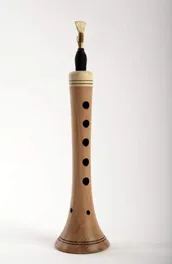
Although zurna (Figure 1) is a very common instrument in Byzantine music, it has been mostly used by Turkish-Cypriots, and rarely by the Greek-Cypriots. It is a double-reed woodwind instrument, which has a similar mouthpiece to an oboe. Walnut tree is used to produce the instrument. Its length is usually between 20 and 30 centimetres.[4]
Davul
Usually employed to accompany the zurna, davul is a sizable double-headed drum, played by two mallets. Its heads are mainly made of wood or metal. The right-hand drumstick is utilised for the accented beats (notes or syllables emphasised) on one head, and the unaccented beats are played by the left-hand stick on the other head. The davul player would carry the davul by fastening a rope around his neck.[4] Davul is also a very common instrument in the eastern Mediterranean and the Middle East. Similar to zurna, davul is usually played by the Turkish-Cypriots because it was received from the Huns during the Ottoman Empire period.[14]
Toumberlekki/Darbuka
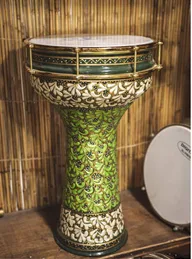
Darbuka (Figure 2) for Turkish-Cypriots, or toumberlekki for Greek-Cypriots, is an oriental percussion instrument, mainly used to accompany the violin and ‘ud by Turkish Cypriots. Greek-Cypriots also started using it during the 1990s, and it gradually became a more popular instrument.[4]
Def
Turkish-Cypriots also play the tambourine, which they called def. Def is essentially used to accompany the women’s dances, such as çiftetelli.[2]
Indeed, these traditional instruments were very common in the folk dances and music of Cyprus between 1960-1974. During the 1960s, special cultural occasions, such as in weddings, the violin would have mainly been played with an accompanying instrument. All instruments were played by professionals, mainly during the village festivals.[15] Performers would either learn to play the instrument from their relatives, masters or by themselves.[16] Thus, instruments described above played an important role in identifying the cultural folk tradition.
Conclusion
Overall, although there was some exposure to ethnic, political and sociocultural modulations within the dimensions of Cypriot geography, common folk dances’ and music’s repertoire and instrumentation still instigate the "Cypriot" tradition. The next chapters will discuss two distinct periods, 1960-1974 and 1974-2003, to understand the political, sociocultural and musical effects affecting the Cypriot folk tradition’s survival and downfall.
Notes
* The exhibitionist dances were presented independently or individually by men, which let the dancers to show their own dexterity, bravery and power. These dances are:
1) Tatsia/Elek: The folklorist holds a "sieve" in one hand and a glass of water in the other. He steps on the stage to the rhythm of the musical piece. Afterwards, he places the glass of water in the sieve and rotates it around extremely fast without leaking a drop of water. Lastly, he salutes the audience and vacates the stage.
2) Drepani/Orak: The dancer performs the act of harvesting to the music of violins and the lute. The dancers act to the same music in these dances. The music is in tripartite A-B-A form (in three-part form), and the metre changes accordingly to the music. The dancer leads the musician by choosing the start and end time of the piece while dancing.
** Arapies Dance (Horos tis Kantilas/Arabiye): “This is performed by a single dancer who places a glass of water on his head. In order to fix the glass, he has to place a handkerchief on his head and then he turns it upside down.”[10]
Bibliography
[1] Garanti, S., Kıbrıs Havaları [Cyprus Music]. Motif Akademi Halk Bilimi Dergisi. 327-332 (2013a).
[2] Kozanoğlu, S. & Derzinevesi, H., Kuzey Kıbrıs Halkdanslarında Anadolu Esintisi. Journal of International Social Research. 9, (2016).
[3] Samson, J. & Demetriou, N., Music in Cyprus. (Surrey: Ashgate Publishing Limited, 2015).
[4] Tsangardiou, E., One Music, Two Labels. in Music in Cyprus (eds. Samson, J., & Demetriou, N.) 37-56. (Surrey: Ashgate Publishing Limited, 2015).
[5] Demetriou, N., Vasilis K., Katy R., & Kenneth O. S., Cyprus. Grove Music Online. (2019).
[6] Papadakis, Y. & Hatay, M., The Cultures of Partition and the Partition of Cultures. in Music in Cyprus (eds. Samson, J. & Demetriou, N.) 19-36. (Surrey: Ashgate Publishing Limited, 2015).
[7] Özkirimli, U. & Sofos, S. A., Tormented by History: Nationalism in Greece and Turkey. (London: Hurst, 2008).
[8] Giray, A., Original Works with Traditional Cypriot Musical Character and Their Universal Repercussions: Original Cypriot Music Inspired by a Documentary. in 1. Kıbrıs Havaları Sempozyum Bildirileri [Proceedings of the 1st Cyprus Songs Symposium] (2011).
[9] Islamoglu, M. & Oznur, S., Geleneksel Kibris Turk ve Rum Dugunleri (Traditional Turkish and Greek Cypriot Weddings). (Nicosia: Gokada Yayinlari, 2010).
[10] Averof, G., Ta Dimotika Tragoudia kai oi Laikoi Horoi tis Kyprou [The Folk Songs and Popular Dances of Cyprus]. (Nicosia: Bank of Cyprus Cultural Foundation, 1989).
[11] Garanti, S., Kıbrıs havaları [Cyprus music]. Motif Akademi Halk Bilimi Dergisi, 327-332 (2013a).
[12] YouTube., Feslikan - Turkish & Greek. (2010) https://www.youtube.com/watch?v=HbFz-zwrEsQ. Accessed: April 28, 2019.
[13] Karayanni, S. S., Moving identity: dance in the negotiation of sexuality and ethnicity in Cyprus. Postcolonial Studies, 9, 251-266 (2006).
[14] Derviş, Nur., Cinuçen Tanrikorur et la tradition du ud ture. Cahiers de Musiques Traditionnelles 2, 255-262 (1989).
[15] Azgın, B., Transforming Culture: Traditional Music and the Turkish Cypriots. in Music in Cyprus (eds. Samson, J. & Demetriou, N.) 77-88 (Surrey: Ashgate Publishing Limited, 2015).
Photo: By Matěj Baťha - This photograph was taken with a DSLR from WMCZ's Camera grant., CC BY-SA 3.0, https://commons.wikimedia.org/w/index.php?curid=16677374.