

Evolutionary Origins of Human Immunodeficiency Virus
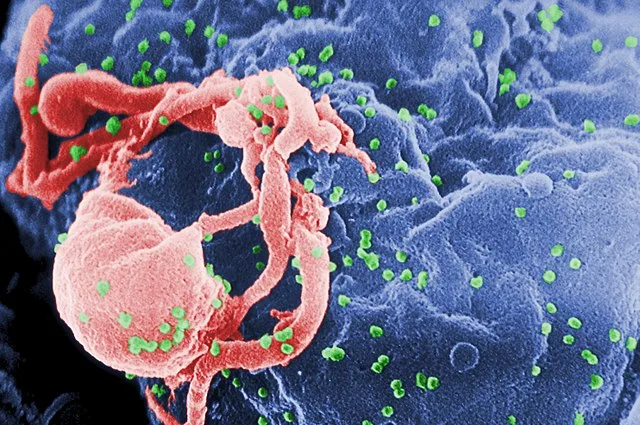
Acquired immunodeficiency syndrome (AIDS) is caused by the human immunodeficiency viruses HIV-1 and HIV-2.[1] These are known as human retroviruses and they insert a copy of their genome (RNA) into the DNA of the host cell.[1] They spread through sexual and perinatal (during pregnancy or after birth) routes and attack cells of the immune system called CD4 or T cells.[1] Consequently, CD4 depletion weakens the immune response and the body cannot fight off against infection. Despite the absence of an effective vaccine, antiretroviral therapy (ART) is used for treatment, which results in viral suppression and lowers risk of sexual transmission.[2] In 2019, the number of individuals living with HIV was recorded to be approximately 38 million worldwide, with the majority being in Sub-Saharan Africa.[2] With millions of new cases and HIV-related deaths, AIDS is still a global health threat and ongoing scientific research shows hope for ending the HIV epidemic in the near future.
Close relatives of HIV: Simian immunodeficiency viruses (SIVs)
To understand the evolutionary origins of HIV, their evolutionary relatives must first be considered. Simian immunodeficiency viruses are natural pathogens of Old-World monkeys (family of primates) and they have close evolutionary relationships with human immunodeficiency viruses.[3] SIVs are important in the study of HIV and how humans acquired it, as there are simian relatives of HIV-1 and HIV-2 (in other words primate versions of HIV) in chimpanzees and sooty mangabeys (a species of Old-World monkeys) respectively.[3] Primate viruses are thought to have emerged approximately 6-10 million years ago and some of these viruses have crossed the species barrier (transmitted from one species to another).[3] In this way, they have evolved to generate new pathogens through cross-species transmission. This suggests that humans have acquired AIDS from different primate species in Africa.
Origin of SIVs in chimpanzees (SIVcpz) and gorillas (SIVgor)
SIVcpz is only found in two out of four subspecies of common chimpanzees, namely central and eastern chimpanzees located in areas ranging from Cameroon to Tanzania.[3] Its absence in other subspecies (western and Nigeria-Cameroon chimpanzees) suggests that the virus was acquired after divergence into different subspecies. Since chimpanzees hunt other mammals [4], including monkeys, predation is believed to be the major source of viral transmission in addition to reproduction and migration.[4] On the other hand, SIVgor is likely to be transferred from central chimpanzees to gorillas 100-200 years ago.[3] Considering gorillas are herbivores,[3] the transmission event could not happen by predation and must involve an overlapping feeding region in the forest to allow at least one encounter.
HIV-1: gorilla or chimpanzee origin?
Instead of being a single virus, HIV-1 has four distinct groups, namely M, N, O, and P. Group M is the pandemic form, whereas group O and N are restricted to Cameroon, and Group P has been identified only in one Cameroonian.[3] Due to HIV-1 M and N groups and SIVgor sharing the same evolutionary cluster with SIVcpz from central chimpanzees, chimpanzees are shown as the original source of human and gorilla infections.[3] Further phylogenetic data suggests that group P originated from gorillas and group O from either chimpanzees or gorillas, which highlights the need for further research. Regarding the transmission of ape versions of four groups of HIV-1 to humans, it must have occurred by exposure to body fluids or blood of infected apes.[3] Such events are likely to have occurred in the context of meat-hunting in west central Africa, where human-ape interactions led to different cross-species transmissions.[5]
Origin of HIV-2
HIV-2 is similar to HIV-1 in morphology but is different antigenically.[6] It also shows lower transmission rates and viral load (most infections do not progress to AIDS) and is restricted to west Africa.[6] On phylogenetic terms, HIV-2 is more closely related to SIV in macaques (another species of Old-World monkeys) than it is to HIV-1.[3] As mentioned earlier, HIV-2 in humans is similar to the SIV in sooty mangabeys.[7] Owing to the fact that humans in west Africa hunt these animals for the purposes of agricultural pest removal,[3] it is highly likely that HIV-2 strains were transmitted through such a route.
Relationship between disease emergence and anthropogenic activities
Infectious diseases in humans often emerge as a result of pathogen transmission from animal hosts to humans. At the global scale, anthropogenic activities such as wildlife hunting, domestication and habitat disturbance contribute to disease outbreaks through close contact with wildlife.[8] In addition, habitat fragmentation, land conversion and exploitation have a negative impact on natural habitats and increase the likelihood of animal-human interactions; all of which are enhanced by altered distributions of animals that try to acclimate or adapt to human actions.[8] Supporting evidence suggests that domesticated species share eight times more viruses with humans compared to wild species.[8] Moreover, the number of viruses causing human diseases is two times higher in endangered species due to habitat loss and human exploitation.[8] It is important to realise that a reasonable number of human diseases such as SARS, Ebola and MERS originate from different mammals, especially primates and bats having the highest number of zoonotic viruses (viruses transmitted from animals to humans).[8]
Conclusion
Overall, both HIV-1 and HIV-2 emerged as a result of multiple cross-species transmission events of SIVs present naturally in African primate species. These facilitated the evolution of viruses and their spread in humans, where only a single transmission in southeastern Cameroon involving SIVcpz from chimpanzees resulted in the pandemic form HIV-1 group M. In the wake of the coronavirus pandemic, it is essential that awareness is raised about the vital link between human-animal health. Thinking of disease emergence as an environmental problem, it is of great significance to realise the impact of human interactions on wildlife and adopt more sustainable ways in order to co-exist and to live in a healthy planet.
References
[1] Cohen, M.S., Shaw, G.M., McMichael, A.J., Haynes, B.F. Acute-HIV-1 Infection: Basic, clinical and public health perspectives, N Engl J Med, 364, 1943-1954 (2011).
[2] Centers for Disease Control and Prevention. Global Health Policy: The Global HIV/AIDS Epidemic, https://www.kff.org/global-health-policy/fact-sheet/the-global-hivaids-epidemic/ (2020).
[3] Sharp, P.M., Hahn, B.H. Origin of HIV and the AIDS Pandemic, Cold Spring Harb Perspect Med, 1, a006841 (2011).
[4] Bailes, E., Gao, F., Bibollet-Ruche, F., Courgnaud, V., Peeters, M., Marx, P.A., Hahn, B.H., Sharp, P.M. Hybrid origin of SIV in chimpanzees, Science, 300, 1713 (2003).
[5] Aghokeng, A.F., Ayouba, A., Mpoudi-Ngole, E., Loul, S., Liegeois, F., Delaporte, E., Peeters, M. Extensive survey on the prevalence and genetic diversity of SIVs in primate bush-meat provides insights into risks for potential new cross-species transmissions, Infect Genet Evol, 10, 386–396 (2010).
[6] De Silva, T.I., Cotton, M., Rowland-Jones, S.L. HIV-2: The forgotten AIDS virus, Trends Microbiol, 16, 588–595 (2008).
[7] Chen, Z., Luckay, A., Sodora, D.L., Telfer, P., Reed, P., Gettie, A., Kanu, J.M., Sadek, R.F., Yee, J., Ho, D.D. Human immunodeficiency virus type 2 (HIV-2) seroprevalence and characterization of a distinct HIV-2 genetic subtype from the natural range of simian immunodeficiency virus-infected sooty mangabeys., J Virol, 71, 3953–3960 (1997).
[8] Johnson, C.K., Hitchens, P.L., Pandit, P.S., Rushmore, J., Evans, T.S., Young, C.C.W., Doyle, M.M. Global shifts in mammalian population trends reveal key predictors of virus spillover risk, Proc. R. Soc. B, 287, 1-10 (2020).
Photo: C. Goldsmith. https://commons.wikimedia.org/w/index.php?curid=3909584.